The Image Below SHOULD NOT BE USED FOR DELAYED START I don’t do Delayed Start – Use at your own risk but it “works for me
Order to “Load Pan” First In = Bottom of Pan 1. Liquids 2. oils 3. (Yeast controls) Salt, Sugar 4. Flours 5. Vital Wheat Glutne 6. Yeast/Leaveners (Baking Powder,
NOTES: Sourdough. IF you are using “wet” sourdough, Sub 1 cup of Sourdough for 1 cup of flour AND REDUCE other Liquid (Milk/Water/Juice) by 25 % BE SURE TO MONITOR HYDRATION during 1st 10 minutes of starting machine.
7: Additives. Read Recipe instructions a time or three until you are sure what it is asking you to do. USUALLY the Additives beep is After the first Rise/Ferment and just as the second Stir occurs. NOTE: I also have chosen NOT to use the automatic thing for additives. I am fussy and it seems that EITHER it fails, OR, it dumps the ingredients, but as “ugly clup” so my preferences is to be hands on and roll in the additives after removing the paddle – time chart math may be required.
Misc to be explained, how to “time” when you need to come back to the kitchen to add things.
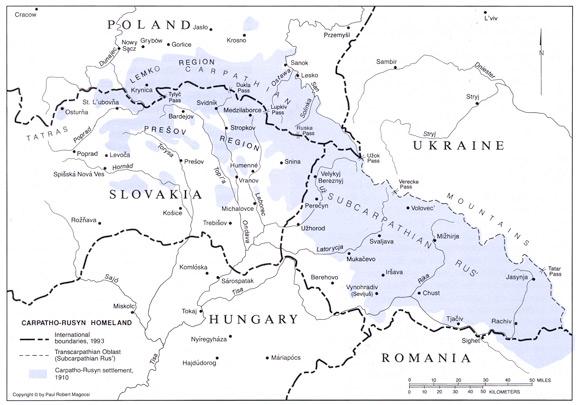
Map found at SimplySlavic.org as part of a brief overview of the history of the Carpatho-Rusyns region – includes 1910 Map of Carpatho-Rysyn over 1993 Poland, Ukraine, etc
Personal Reaction/Review: While not a huge sports fan, it was fun to find members of my Dad’s extended family mentioned. Each of the featured sportsmen has a “2-page spread” sort of like a detailed Obit. However, as someone new to “on-line” genealogy, I am really happy to have the list of resources for more information on the Carptho-Rusyns and of course happy to have supported the writer in what I suspect was very much a “labour of love” project.
Between 1880 and 1914 nearly 250,000 people, known as Carpatho-Rusyns, immigrated to America from a region in Eastern Europe called Carpathian-Rus’. Prior to 1918, Carpathian Rus’, which comprised a land mass similar to the size of New Jersey, was part of the Austro-Hungarian Empire. It is located where the present-day borders of Poland, Slovakia and the Ukraine intersect in the Carpathian Mountains.
Rusyns, prior to the start of World War I, were primarily illiterate peasants, who lived in small villages and owned tiny five-acre farms, raised livestock, like cows, chickens, goats and sheep, on land unsuitable to produce sufficient crops. To escape the hardships of their native land, Rusyns sought a new life in America. Many were quickly recruited by mine owners as cheap labor to perform hazardous and hard work in the Anthracite coal fields of Eastern Pennsylvania.
Later, steel magnates targeted Rusyns to work in equally dangerous jobs in their mills and related industries in Western Pennsylvania, and adjoining towns and cities in West Virginia and Ohio. Other Rusyns found entry level employment at plants and factories in the metropolitan areas of New York, Cleveland, Detroit, Chicago and Minneapolis.
While these newcomers found it difficult to move up the American social ladder, their first generation Rusyn American sons were eager to assimilate into America. Some viewed American professional sports as their opportunity to achieve success. A few found fame as professional boxers, but most gravitated to America’s most popular team sports at the time – football and baseball.
Two Rusyns – John Jadick and Pete Latzo – became international boxing champions in the 1920s. Ducky Medwick and Nestor Chylak both reached Baseball ‘s Hall of Fame in Cooperstown, N.Y., Medwick as a player and Chylak as an umpire. John Kundla was selected to the Basketball Hall of Fame, for coaching the Minneapolis Lakers to five world championships in the late 1940s and 1950s.
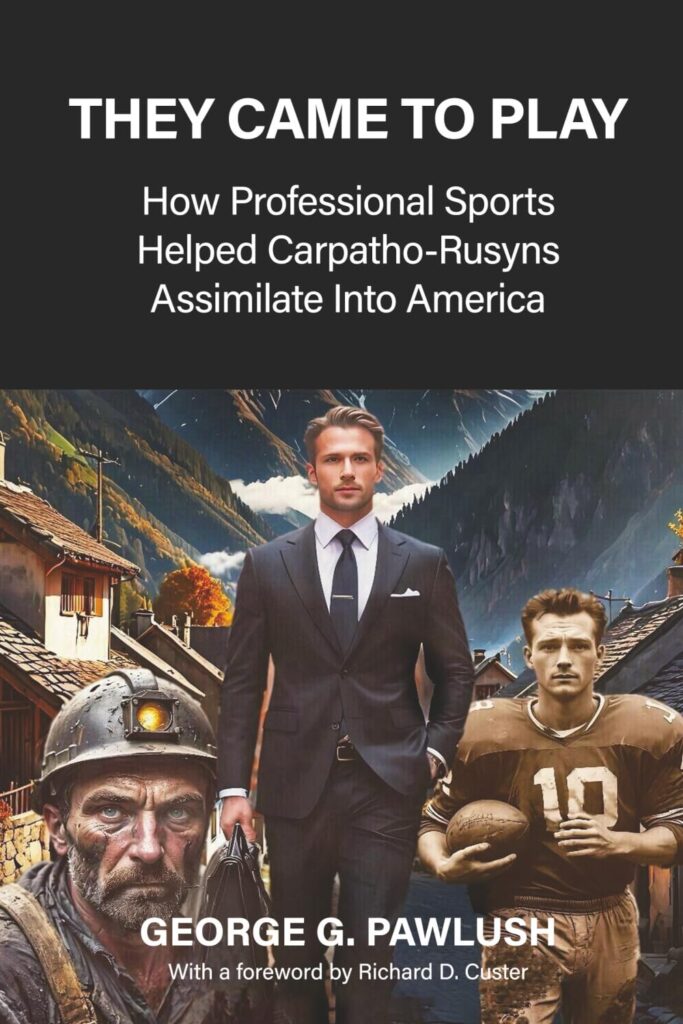
They Came to Play is about the history and homeland of the Carpatho-Rusyns, and about the challenges they faced to become accepted and recognized in America. However, the major portion of the book profiles the lives of the five aforementioned sports figures, and 40 others with Rusyn ancestral roots, who worked hard to reach the top level of their professional or Olympic sport.
These 45 individual served, and continue to be, an inspiration to people with ties to Carpathian Rus’. They demonstrated to their fellow Rusyns that persistence and a strong will could lead to success in whatever career path they chose. By 1960, many second-generation Rusyn Americans had earned college degrees, and advanced up the social ladder, and had assumed major management and professional roles in American business, industry, government, education, and health care.
Amazon Details: Product details Dimensions: 6 x 0.35 x 9 inches ASIN: B0FJ5VKS3D Publisher: Independently published Publication date: July 29, 2025 Language: English Print length:153 pages ISBN: 979-8291466407
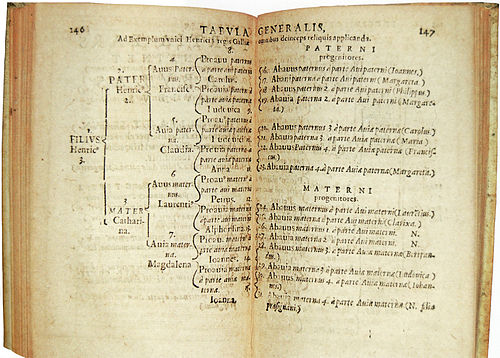
What is the Ahnentafel? According to wikipedia: Ahnentafel, also known as the Eytzinger Method, Sosa Method, and Sosa-Stradonitz Method, allows for the numbering of ancestors beginning with a descendant. I like the Ahnentafel system because it is a nice balance between “just the facts”and a bit of narrative. Now I just need to learn how to properly modify the standard template in RootsMagic to include comments & notes.
Shown below is an image from Wikipedia that is from “The first Ahnentafel, published by Michaël Eytzinger in Thesaurus principum hac aetate in Europa viventium Cologne: 1590, pp. 146-147, in which Eytzinger first illustrates his new functional theory of numeration of ancestors; this schema showing Henry III of France as n° 1, de cujus, with his ancestors in five generations.”
it It has always been one of the best times in our lives when we “made food” together as a family. The only difference really for parents today is so many recipes that are intended to bring your family together.