December 26th, 2018 at 10:11 am
One of those sayings that is all too true is that one does not get a second chance at a first impression, do overs maybe, but not first impressions.
Pattern Editors may or may not be exposed to the photo of the project, but often their first impression is entirely based on the text.
A lot about the likely quality of the pattern instructions can be determined in Tools, Materials and Supplies listing. Just the presence or absence of it being followed by a “Stitches Used” listing.
it is my strongly held opinion that in today’s world those who do not list Metric are doing their potential customers a severe dis-service.
Any pattern author or even pattern user can easily see that “just letters” or just “numbers” don’t work if they actually look at:
https://wheatcarr.com/crochet/wheats-aluminum-crochet-hook-cross-reference.php
this chart is only a starting point, as due to some recent changes in sizing by several manufacturer it is in need of updating for purposes of “currently available”.
It is even more vital that metric sizing be included when referring to “thread” hooks since there are several standards (although I prefer the Japanese) Yet, even that can change of the years.
The meaning of D is not only subject to the Manufacturer whim, but even within the same manufacturer, may change suddenly. I have some BOYE size N that are 9.00mm and some that are 10.00mm –
I remember one particular author who had no idea (and we were unable to explain) how to use a caliper
In fact, a Pattern Author who wishes to “skimp” on the details, should, IMNHO, give metric diameter – since it is more universal and not subjectively based on the manufacturer other than for accuracy
Someday I need to finish this.
June 25th, 2016 at 12:45 pm
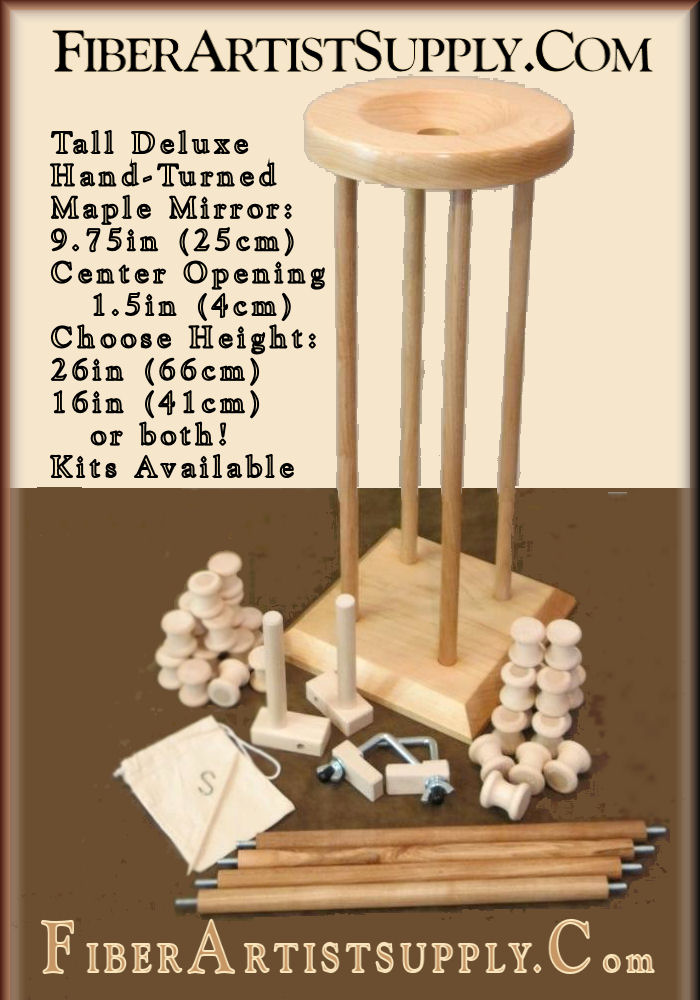 The purpose of this article is to share a starting point of the information necessary to make the best possible investment – time or money – in your choice of braiding equipment.
Let me make it clear – There is nothing wrong with using a disc or improvised or self made braiding equipment. If that is what is currently in your budget. Many of us have; some including me, still do use both MaruDai and other types braiding stands, just remember flat tops are not Marudai and your results may not be of the quality you hope to achieve. And, I DO recommend you “buy a book” and try with improvised equipment as the first step in your research.
In their beginner books Carey & Owen give ideas for improvised equipment – and see if you enjoy it. the braids will not be perfect or wonderful, that comes with better equipment and practice. Remember: There are many types of braiding equipment not every stand is Japanese in style, or evea a MaruDai and it cannot be said often enough – NOT all braids are Kumihimo.
What makes it a Marudai and not “just” a braiding Stand? Whether you know the Japanese name: Hakomi or the often used “English” words like Scoop or Well or Bowl …
The Hakomi Matters.
Without a Hakomi it is not a Marudai
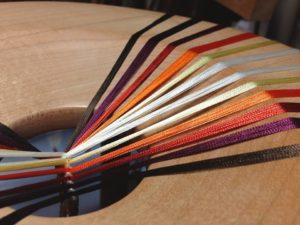 Hekomi Side View
courtesy: Michael Hattori
Why is the Hakomi critical. Perhaps the best answer can be found in two message threads in the FaceBook group: Kumihimo Braiders International in July of 2014 when Michael Hattori was asked, as part of the discussion related to his “announcement:” of his YouTube video and shared with his specific permission:
.. how important is the well in a mirror? I bought one without a well ….
And Michael responded: … we are talking about basics.
The “well” is one of my soapbox topics, and you asked for it! The well is one of THE most important features of a marudai, and in my opinion, any marudai without one should not be used. Its purpose it to provide a “free” space where the threads do not touch the marudai; this allows the threads to fall naturally into place. The depth of the well also causes the threads to angle down toward the point of braiding – another feature which helps the braid to form correctly.
If your mirror is completely flat, the threads move in a straight line to the point of braiding; this means there is friction on the thread almost all the way to the point of braiding, which impedes the formation of the braid. If you are doing just a Yotsu-gumi, you can get away with it, but once you start working with larger numbers of tama, it is absolutely essential.
I’ve said it a million times before, and I’ll say it again: kumihimo has been around for centuries, and the Japanese are known for their ability to refine things to levels unprecedented elsewhere in the world. So, you can bet that every single design aspect of a marudai has been thought out and trialed over hundreds of years and nothing has been left to chance.
It is the folly, unfortunately, of many people who try to make their own kumihimo equipment that this is not taken into consideration, and essential things such as the well are left out.
My advice is to either get a marudai with the well, or find someone who can put one on the marudai you have, paying very close attention to the width, depth and curvature of it.
Sorry for the novel, but you did hit on one of my biggest pet peeves about homemade kumihimo equipment! But I hope I’ve helped you to understand the importance of using a properly made marudai.
2014-07-28 in KBI, Michael shared photos and this additional thoughts.
For … anyone else interested in the “why” of the well on a marudai: a picture is worth a thousand words.
Many homemade marudai are missing this essential feature. These photos show the downward angle and the all-important free space created by the well, both of which allow the braid to “breathe” and form naturally at the point of braiding. The problem with a completely flat mirror is that the threads are then subjected to friction almost all the way to the point of braiding, which can impede the correct formation of the braid; the more tama you are using, the more important this feature becomes.
The marudai has been around for several centuries, and with the Japanese penchant for ultra-refinement, you can bet they haven’t missed anything! So, in my humble opinion, if it ain’t got a well, it ain’t a marudai!
Michael has established the minimum criteria for “what makes it a MaruDai, Well, exactly” – it does not mean other equipment cannot be used, it is just not a MaruDai – Like Michael Hattori I agree if it lacks a Well, then it is not a MaruDai, it is a Braiding Stand – and that tool also has an honorable history, but its roots are not in Japan.
I understand personal budget issues, so like many, it was quite a while before I could afford a Marudai that would “works best for me”. Well worth the wait. That does not mean my braiding stand(s) have not been used, and each as a personal history – only that I always knew my traditional braids would be so much better when I had one.
Meanwhile, for some of the more non-traditional work, beaded braids, wire word and of course – occasional side trips into Victorian Hair work, the flat top continued to be adequate to those tasks.
Thinking about making your own?
Michael Hattori’s measured drawing can be downloaded from my Kumihimo Links Page
added 2015-Jan-09: Not sure if it is mentioned in the Measured Drawing PDF – there are different schools of thought on the height – as was recommended to me (and reinforced by learning the reality the hard way) the top of your mirror should be about the same when you arms are at straight down your side from shoulder to elbow and your forearm is at a 90-95 degree angle to your body. With good back support, this enables me to braid for longer periods
Want to chat about this and related Jewelry & Accessory Making? Join us on FaceBook at: Braids Beaded Kumihimo & More with many thanks to Makiko Tada, Jacquie Carey, Michael Hattori, Carol Miller Franklin, Maryse Levinson, Shirley Berlin, Tim Hale (FiberArtistSupply, Carol Haushalter (Carolyn910), Janis Saunders (BraidersHand). Anita Clark and dozens of others for their permission to include their thoughts and illustrations. Not to mention their decades of patient willingness to answer all my questions about the details and delights of Kumihimo and all braiding techniques.
originally published (and still shared) via ItsAllJustString.COM – Kumihimo and Braiding
Marudai’s I have used and happily recommend: *click for larger image in a new window”
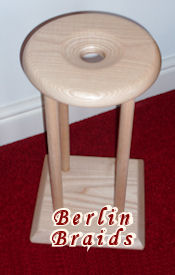
Berlin Braids
|
|
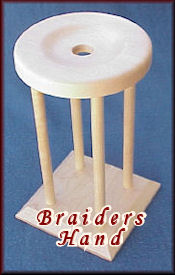
BraidersHand
|
|
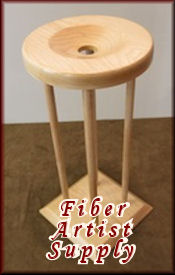
FiberArtistSupply
|
These books will be valuable to you even if you decide to stick with the Disc. There are many “details” of braiding that will better enable you to take the step from Disc to Dai
June 3rd, 2016 at 06:19 am
 Kongoh Gumi is one of the easiest and most versatile of braids. One of the variations that are invaluable to the Jewelry and accessory braider – with or without beads is understand and use the the S & Z twist methods for design purposes.
After reading the latest entry to Carolyn910’s blog on S & Z and how to reverse the twist within a braid, I did the “stare & compare & converse” which led to a few hours, using different stringing materials – each size of 4 sizes S-Lon cord – quadrupled floss – Asian knotting cord – 2 sizes of Satin Cord – and 2 sizes of para type cord. and 1 of micro.
In Comprehensive Treatise of Braids Vol VI: Kumihimo Disk & Plate by Makiko Tada, the instructions on pages 16 & 17, do not suggest this step. The result (most apparent visually and tactilely) without the flip was a less refined point in the turn.
Likely “okay” if working a fully beaded braid, but noticeable (if you look closely at the illustration of actual braid, you can see the small dent. I would imagine this might be easy to fix by steaming if one were working the braid using bundles – or in the fully beaded braid – the extra step of massaging the the braid I keep reading about.
Mentally, the “flip of the disc” seemed to reinforce the “change of direction” – making a sharper point and so I did (a lot) less unbraiding – so I really thing it is one of those “good habits” that will save you time and energy and produce a better finished work – with less aggravation during the process.
The only thing I might have worded differently is to say to mirror the threads when changing the direction of the spiral. – it was confusing to me since in most photo editing software flip and mirror function differently.
Now back to a day of doctors, PT and studying software, all much less fun than a few hours of braiding as an escape from silly software nonsense (still working on the web store upgrade)
When it comes to braiding, like my Momma used to say:
The Devil Is ALWAYS In The Details
There is certainly a great deal more details of the How To for S & Z Twist for the Disc & Plate braider and jewelry and accessory maker, there are few blogs better so be sure to read and learn at
Carolyn910’s Topcenter Kumihimo Disc & Plate for the rest of the story
Wheat
http://www.EnjoyTheMaking.com
P.S. Thanks to Carolyn for permission to share her image for this blog commentary
P.S. Jr: PDF Link to BeadSmith Z Spiral Instruction included with their disc,ItsAllJustString.com Braiding Resource links at: http://itsalljuststring.com/index.php?main_page=index&cPath=160_165
April 12th, 2016 at 06:57 am
In my mind, thinking of craft and especially fiber work. There is a world of difference between
—- Wanting to be be Correct – thus, by necessity, a willingness to research, ask questions, especially dumb questions and sometimes question where you think you already know the answers, And most importantly of all – accept correction. And the often difficult to accept “tough love”
— Wanting to be Right simply means because I said so. Were my parents alive today, they would tell you that while I might comply – it was never an answer that taught me anything other than nominal obedience.
A reasonable person might think I had learned by now that most will choose easy or a version of correct that suits their needs personally or most often “business”. Yes I understand, but no I choose not to accept – because that is not the tradition I want to be a part of.
My personal goal is to leave what is “right” to the emotional and spiritual like “sex, religion and politics” because those often subjective. but when it comes to the craft, work on correct –
April 9th, 2016 at 08:40 am
As I mentioned, sometimes the inspiration for “getting it done” is seeing a few to many repetitions of an InterMyth (and the side effects of parents raised during the Great Depression so there is an element of furgality) So it was with Fill The Gap. it is a great braid for accessories, but is not Japanese in origins so not Kumihimo.
There are other sources for its instruction and some might even be better than mine – but my goal is to help you learn the basics and then you choose how to go on after that.
The first step is “elapsed” time. The only way to even remotely avoid infringement is the need to start with a blank pieces of paper, or in my case, choosing not to look at /review the work of others for at least 6monts to a year for the particular braid.
Next I wind up some tama and spend a few hours getting back the rhythm of the braid on Marudai. After that comes what Henry refers to as the slot machine braiding ( comes from the slang for slot machines – the one armed bandit – based on the year I broke my arm and it took a few resets to get the bones back where they belonged)
As with many things Japanese, braiding movements are very much about balance, so “two handed” – which means if working on disc, when only one tama / bobbin is moved at at time – there will be TWO half steps.
Thanks to permission from the BeadSmith to use their images – I make up a number of sheets with two “discs” side by side and room for notes – these are more or less 1/2 sheets of letter size.
I have mentioned before that because I come from MaruDai to Disc – and thus have seen how much more easily the transition can occur if one is always in the habit of not turning the disc – I don’t… ever
It is my understanding that Makiko-sensei and others do to make it simpler – but my feeling is turning the disc just creates an obstacle to overcome later. Like many things, if you never start, the habit is easier to break
Anyway, back to my process. working one hand at time, making notes (adding arrowed lines – noting numbers, etc) I work thru the braid to find the the full repeat (all the steps/half-steps) needed for one cycle of movements to build the structure.
Repeat a few times (okay maybe a dozen) (STILL ON MARUDAI) to confirm – at least enough times to “see” that the braid does “match” the expected pattern and shape.
If all the sketches are clear and “okay” then time to put them to the test on Disc. This is also when I do enough repeats to find how many repeats are needed to return the bobbins to the original starting position. Just because one uses the same slots over and over does not mean the same tama “finish” in the same place.
This is a detail you need to know for purposes of surface design yarn color or with beads.
In not all that long time, this would be the point that the written instructions should be produced – in my case – I talk the sequences out loud which does annoy some people – recording as I go – using notation/comments likely more familiar to those who have weaving and/or crochet or knitting experience –
To start Round 1, with Left hand lift bobbin A from slot 32 and place in lot 18, with right hand lift bobbin B slot 1 to slot 15″ – repeating until bobbin A and all the others have returned to their original starting position. Then I play back and make the braid according to the verbal instructions , on the disc.
Again to use a term most weavers will recognize, –
Tromp As Writ –
If these were to be formally published, once the quick and dirty diagrams and verbiage has been refined a bit – this is point where I would be having a group with varied experience trying these instructions.
More refinements and editing, some q&d images would go off to a graphics person with more skills and tools than I possess. to prepare better diagrams and edit as needed for formal publication.
However, my current “project” is not intended for publication and certainly not something that I expect to be paid for. It is always welcome when others in the Beaded Braid community pitch in –
trying instructions and asking questions, or as Cheryl was so generous to do recently – making photos so you could see that all important point of braiding.
This is just the first part of the process — the braid structure –
after than comes mapping – sometimes easy and sometimes tedious.
I hope that by sharing a small part of the process it will help you to understand some of my eccentricities related to Intellectual property and of course, what “belongs” in a publication for it to be called a tutorial – and oh yes, fair warning, few things make my teeth hurt more than the phrase “standard braid” there is no such thing.
And, I am looking forward to “getting these done” because one of my rules is that I cannot use my books (marudai or disc) while this is ongoing.
Thanks for listening,
I hope you will share what you do with these instructions
so now it is time for you to go
Enjoy The Making
Wheat
P.S. currently there are instructions for my variation on
Kusari_Tsunagi – an 8 element round braid that has “straight” lines (does not spiral) among others in our Face Book files for Braids Beaded Kumihimo & More
Fill The Gap – a 7 element round braid has two parts, the “History” and SetUp & Stepouts are available on my e-commerce site – ItsAllJustString.com
and eventually all will find their way to the underdevelopment site’s AllJustString.com