April 8th, 2016 at 07:47 am
Inspiration and Tutorial as such lofty words. Sometimes too much so… but they also often “fit” even when said Tutorial is really, as often happens in beaded braiding, nothing more that a set up diagram, a smidgeon of materials used, and a stringing order.
So a bit of history – I am “first” a “Marudai braider” – several decades ago I started with braiding stands and the limited information available in books like the Mark Campbell classic on Victorian Hair Braider.
It is said there are two types of artisan craftsmen and it is especially true in fiber work. There are Process & there are Project –
I am very much a Process person. Working with fiber is, for me, something soothing to my soul. There really is almost no part of the process I do not enjoy – and that one thing is not really a fiber thing – I just don’t like the fume headache that comes with glue –
I also recognize how very lucky I have been beginning as a toddler learning crochet from the “cookie lady” (a neighbor) to today when I have access to wonderful master craftspeople – “raised in the fiber tradition of sharing knowledge” for the good of the craft.
I also think of myself as lazy – so will spend hours, days, weeks, and one case unrelated to fiber crafts or food – finding a way to do it more easily.
There is also more than a little OCD in my quest for knowledge and understanding How It REALLY Works – I blame my parents for that – Other mothers may have preached about clean underwear in case you were in an accident, but valued knowledge – a step past “an education”.
Knowledge is something that only God can take away from you –
once you learn “basic skills” whether that is a beading stitch or a braiding structure – you are freed from the choices of others in the final look of your work.
Of course there are considerations about what and how to share. Still, given my history in the independent design community (few have been removed from as many “craft” groups as I for asserting a defense of the limitation of copyrights and thus doing what I can to protect the intellectual property of self publishing authors – I am quite careful – keeping the kind of copious notes ( learned the importance of that when dabbling in law classes ) so do not publicly share unless I really feel confident about my ethical and moral position
So where does that leave me. Well if I had to choose my greatest super power – it would be not knowing it all, but being willing to look dumb and ask for help. No one really learns anything if they pretend to know it all .
Second to that is knowing where (who or book) “off line” to look for accurate information. So my boring habit of referring people to the books that are, in my never humble opinion, the best resource.
I am also a great proponent of ( and shall miss Jamie, Adam & the crew) of busting InterMyths.
This group, Braids Beaded Kumihimo & More is intended to be a study group where you can, if you wish learn some basic braids. Unfortunately (again IMNHO) the first InterMyth in need of busting is there is such a thing as “the standard Kumihimo braid” –
I do not mind (never have) that some are going to find Kongoh Gumi to be all they want in their skill set – it is after all, Kongoh gumi is likely most “bead friendly of braids” Lord knows given the range of seed colors and shapes available – one could spend years creating varied surface design.
But there are others, some Japanese in origin and some from other ethnic fiber cultures that are not – so maybe the real first myth to be busted is
“While all kumihimo are braids, not all braids are Kumihimo (Japanese) in origin.
Enjoy the Making
Wheat
P.S., over the coming months I will be sharing my choices for “Bead Friendly Braid Structures” and developing the set up and steps to make them on a disc (and maybe some on plate) Hope you will consider joining us at: Braids Beaded Kumihimo & More
April 8th, 2016 at 06:05 am
Inspiration and Tutorial as such lofty words. Sometimes too much so… but they also often “fit” even when said Tutorial is really, as often happens in beaded braiding, nothing more that a set up diagram, a smidgeon of materials used, and a stringing order.
Much of my “inspiration” for the series is annoyance with people who either should know better or whatever their motivation – deliberately choose not to give accurate information.
In my strongly held opinion, if a tutorial does not include details (at the very least some basic conventions used I.e., design requires disc be turned counter clock wise – then it is not helpful. There is NO SUCH THING AS A STANDARD Braid – if you want my $$$ then you better do your homework and provide useful information.
So one might say the real inspiration behind my working out the moves for creating specific structures on a disc is a combination of laziness (wanting to find the least number of steps to obtain the desired results) and significant annoyance that those who choose not to take advantage of the PDF Publication process and include a page of basic steps (aka/step outs) –
Even so called advanced tutorials need to at least reference the braid used and if the description only says meaningless things like
Standard – that is clue to the likely value of the content – IMNHO
And so my plan to create a series of Set Up and Step Outs for Bead Friendly Braids,
Hopefully you will enjoy learning the technique and then find satisfaction in applying your choices of materials to make the surface design your own.
Enjoy the Making.
Wheat
March 30th, 2016 at 08:52 am
Like so many things in this life, the following is a work in progress. What seems “clear” to me, may need to be further clarified to make sense to you.
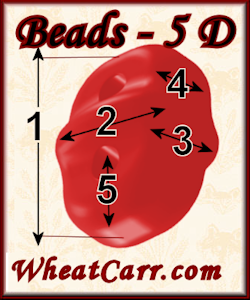
How to choose beads for your braid is a question often asked and so it has me thinking about how do I do that. And, will sharing that help others?
No matter which braid structure the JABber (Jewelry and Accessory Braider) chooses, some combinations will work, and some will not but it helps to know:
1: Maximum Length tip to tip,
2: Maximum Width side to side
3: Maximum Depth front to back
4. Width of bead at the opening – note: sometimes the same as 3.
5. Distance from the center of the opening to the tip.
Fitting beads into a braid structure is not unlike solving a picture puzzle.
For me, the key to puzzle is understanding how the 4th and 5th dimensions of the beads shape will integrate into the body of the braid.
Assuming your willingness to consider all available options one can usually solve your personal concept issues. Options include but are not limited to the use of different structures, bead density Continuous, Fully or Partialy beaded), combinations of bead and stringing materials (1), and the list goes on.
In summary, if you understand the materials and the considerations of the shape, then you are freed from relying on the choices of others.
Whenever possible, braiders tend to like “top drilled” shapes – not the only possible choice – but often the best at least until you have a bit more experience mixing beads into your braids.
There are several inexpensive tools while not absolutely precise, with care, accurate enough to help you plan your project, shop for the beads and stringing materials. These can be found in just about any Home Despot type store – usually for under $10 for all three (amazingly, I do not sell any of them in our store but maybe I should)
As always, your comments, suggestions, request for clarification are welcomed below and in the Facebook (non-traditional) Study Group:
Braids Beaded Kumihimo & More
Enjoy The Making
Wheat
References & Strange things found in my tool boxes & Go Bag. (add images and/or link details as needed)
1. Carolyn Haulshalter: http://topcenter.typepad.com/
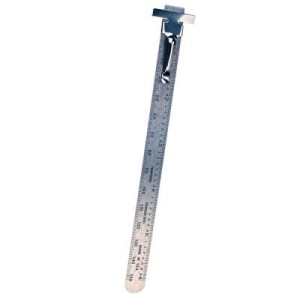 2. Empire 6inch Pocket Rule Item 2730 0-46609-02730-7
 Thomas J Glover – Pocket Ref (2nd Edition – 1997) ISBN: 1-885071-00-0
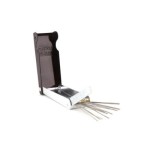
Lincoln Electric Tip Cleaner Item: KH575 7-25636-08020-1
this tool can be used to determine needle to be used for stringing, to hold the bead while measuring and other things “in a pinch” – while shopping (with floss card) to hold enough beads to get a quick Beads Per Inch count.
also to be explained Wikipedia – Drill Bit Sizes – Conversion Table https://en.wikipedia.org/wiki/Drill_bit_sizes#Drill_Bit_Conversion_Table
March 24th, 2016 at 08:16 am
Lots of people do not understand the attraction of Donald Trump – and I have said it might be that maybe one has to have been politically active as a business (not politician) person in NY and the world to begin to understand his attraction.
In my 20’s I had the opportunity to be “in the room” and see him action. I am not a fan of him as a man , but do respect his ability as someone who seemed to find that balance in nearly every instance that is so necessary to a solid business deal –
There is no question that those deals usually had more benefit to the Trump organizations, so yes, the NY “It’s just business” enters the judgement equation.
Still those that closed were the ones where you do not necessarily get everything you want, but everyone gets enough to walk away accepting its terms.
Much is being said about his ability to work with Congress – well, isn’t that what the system of checks and balances is about? Until term limits exist for the members of Congress – The Executive branch should still be able to exercise it ability to contribute to the balance. The self interest of desiring re=election in a all access world means that a fair number of members of Congress will need to act in the something resembling the best interest of their constituents
I am opposed as an American to socialism. I am opposed to the callous disregard of the Clintons and the Obamas for what I perceive as the best interests of the citizens of the United States.
So that brings us to a choice between, at the moment of an obvious party hack – one most likely to continue the policies and practices of division in order to increase and retain personal power, , a caped crusader who may not be able bend in order to get anything done
and a business man with no political track record other than what we see in his life long long business practices (including the common practice of donating to all parties because that is “just business” )
The only thing I am now clear about is not that I want to make American great – I continue to believe the United States is already great –
What I want is President I can believe until proven otherwise that will put the interests of the USA and it citizens first.
March 21st, 2016 at 09:22 am
Some okay much of the confusion about Japanese braiding terms is the direct result of two things.
First, It is often nearly impossible to make a direct translation to a word commonly used in the English Language. This applies to much more than braiding. This is not unique to Japanese – some of my most interesting moments in craft “translating” have involved Russian, Ukrainian, Polish and German.
So, the challenge to authors and teachers focusing on the “English as a first or even second language was to use terms that would make sense to their audience.
Which brings us to the second reason there is so much misunderstanding.
Authors like Tada, Owen, Carey, Berlin, et al – were, for the most part “speaking to fiber people” NOT Bead people. Japanese craft more than most has very unique words for each part of the process, the tools and the materials used.
The result is the mis-use of terms by those who may not have a solid understanding of fiber craft related terms in any or perhaps only in their own native language.
Then, there is the InterMyth factor – a term gets used by a “popular” person and then it gets repeated and pretty soon it is treated as “fact” when really it is the direct result of misunderstanding/lack of knowledge. Not helpful to those who wish to learn beyond the simplest or easiest.
I know that not everyone is a OCD as I may be, although I never ‘filed’ the papers – Setting aside the professionaly taught classes for “the basics” I also spent several years working my way thru each of the HGA (Handweaver Guild of America) COE (certificate of excellence) requirement so I would better understand when those more advanced than I were “talking” Not a path for anyone but then few people have as many college credits as I do because I never cared about a degree – just spent money taking courses of interest to me to advance my knowledge base for a subject.
My personal goal is to help those with a desire to know more but may not have had the advantage of studying other craft to know enough to facilitate their quest for more knowledge and expanded skills.
Once the AKS (American Kumihimo Society) goal of an online wiki for just this purpose – I suppose my work will not be needed. But in the meantime I hope you will join me on this journey and that it will help you to
Enjoy The Making
Wheat

