FC-Wednesday WHEN Is The Season? While web wandering to compare instructions for freezing cucumbers, I came across a “new to me” site what offers information on when produce is “in season” with the very helpful format of giving it state by state. https://www.whenistheseason
I do not really care for “cooked” fruit and vegetables – but still often want the flavor – I have been relearning the craft of preparing food to be used later.
For fresh, Buppert’s/Doran’s Chance, Our favorite local farmer does offer bulk when their fruit and other produce is in season.
Another “nice thing” about Buppert’s is that they also support other small Food Crafters like a bakery and locally grown / made condiments and of course my annual spring basket treat during their early opening weeks.
WIP1 2024-02-15 If you are among those who have adverse (mild to major) reaction to Soy products, AND you like Asian foods – you need to find a substitute. In my case it was either give up Asian inspired dishes or devote the effort to working out a suitable replacement to avoid unpleasant consequences. Who knew the most palatable (to us) was already in my pantry.
The primary difference between Maggi’s Seasoning2 and most if not all brands of Soy Sauce is their basic ingredient(s): Maggi’s Liquid Seasoning is made from wheat and glutamic acids. Soy Sauce is Soy Beans and as part of looking up things for this article, the second ingredient is usually “wheat” possibly a concern for some.
Maggi’s flavor is considered to be a bit more complex, as well as slightly thicker (although that is irrelevant when used as an ingredient. From a flavor standpoint, both add great umani.3 )
When used as an additive to “one dish meals” like stews, chilis, and such it adds that something something that is much missed when it is not there.
When used as a condiment or dipping sauce, some may want to add a tiny bit sweetener or other added seasoning. Sorry to be vague, but having not found one I really like, not ready to recommend. “Straight from the bottle works for us as a Soy Sauce substitute.
If you want more details on the history and uses of Maggi’s I do suggest reading Jennifer McGaven’s recently updated TheSpruceEats article entitled “What Is Maggi Seasoning?”4 So much so that when working on this update, every article I found referenced it “in a good way”.
Among the pleasant surprises related to was Maggi’s Seasoning much lower Sodium rating of 400mg per tablespoon – as compared with Kikoman and various store brands of 920mg Sodium per tablespoon.
The big surprise (to me but then gluten is not my issue) was that pretty much every brand of Soy Sauce also contain wheat.
As with many things Amazon, if you use some of the links herein are affiliate, I may earn a commission which does not effect the price you pay (although looking thru the listing just might) often the best price is found in your local stupid market
Bottom Line: Maggi’s Seasoning, used as a Soy Sauce sub with a 1:1 ration works for us, your palate may prefer something stronger. And, in most cases half the sodium.
Last but not least, this mostly started because I needed a “Fried Rice Solution” one more test to be sure it does, in fact, duplicate as expected and I will share.
Umami the word is currently rather trendy but has been around the culinary world for a very long time. It has been described as savory and is characteristic of broths and cooked meats ↩︎
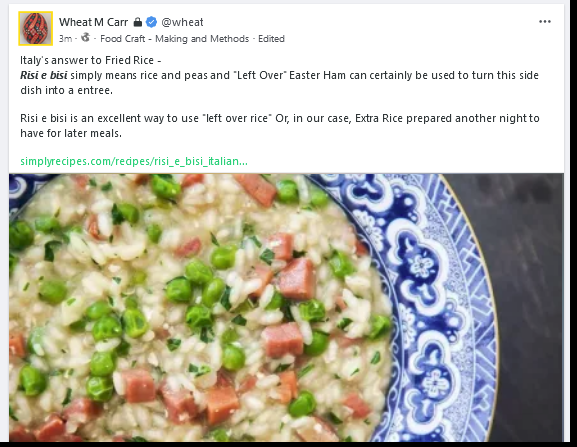
A classic Italian comfort food of rice with peas and chunks of ham An excellent recipe to use left over Holiday Ham.
One of the reason’s I prefer to double if not triple basic rice is to freeze meal sized portions that can be used as the base for Risi e Bisi (and of course “Asian Fried Rice”) either as side of an Entree
Arborio Rice especially lends itself to Risotto, Spanish, Tex-Mex, and Mexican recipes. Although most such dishes call for use of Chicken, we prefer Beef stock.
You will need: Arborio or other risotto rice extra virgin olive oil shallots, minced cloves garlic, minced diced prosciutto or other dry ham beef, vegetable or chicken stock water fresh or frozen peas parsley, chopped grated Parmesan cheese
When to remove the paddle is an often asked question, and the answers vary. So much so that it really needs its own blog. Meanwhile, the possibly most asked question is how to remove a “stuck” paddle.
Always best to try avoiding the problem, but if it does get stuck… The following may help. As shown in the illustration, Many brands include a “tool” to remove the paddle from the inside the bread after baking. This tool should never be used to attempt to remove a stuck paddle from inside the pan. Metal tools, can and will for those who ignore this advice, damage the ceramic finish, the paddle or both.
The answer is an ounce of prevention. If removed from the machine before baking (beginning of last fermentation period) it cannot “burn on”
I (currently) use a brush intended for cleaning reusable straws. The straw cleaning brush helps to really clean inside the paddle. I have the Dawn Hydration Cleaning set – best price usually in your local stupid marketing their gadget aisle. It is also important to clean the stem so any residue does not cause an issue that may make removal before baking problematic
This is an Amazon Affiliate link so you can “see what it looks like” During the bread making process, after years of practice; I learned to remove the paddle just before the last rise/fermentation, remove the dough from the pan, then quickly remove the paddle, either from the pan, or from the dough ball – which ever it decided to stay.
Thanks to the KBS “Power Interruption Feature” This can safely and much more easily be done today by disconnecting the power, dumping out the dough ball into a ball. Removing the paddle from either pan or dough ball. Replace the dough ball, plug the machine back in, and the machine will continue with the program you selected. My “best time” is about 20 seconds, but according to KBS this will work for up to a 15 minute interruption.
If you are a member of the set it and forget it club… and the paddle stays in the bread – Insert the removal hook (2) into the base of the paddle in the bread (3) and the manual then tells you to gentle pull (4) until it slides out.
Again from experience I have a step (3-A) (someday I’ll make an illustration – that day is not today.)
(3-A) Using a Clean oven mitt or Kitchen Towel and maybe this new gadget that Caught My Eye1a few days ago… Hold the loaf (because it is best to do this while bread is still almost hot) Gently pull the hook so the paddle is slightly raising the crust, with a sharp pointed paring knife, CAREFULLY cut a slit along the edge of the paddle. NOW it should come out of the bread with much less damage.
Don’t forget to cool the bread completely before placing in any type of storage bag, box, whatever, to avoid condensation.
This is a draft – so use at your own risk, however, your comments, critic and suggestions are more than a welcome – Thanks for reading.
Inspired by 11 Ways with Deviled Eggs from the Betty Crocker Test Kitchens1 Whether you are “using up” Easter Eggs or starting fresh – Deviled eggs are fun to eat, addictive and frankly my tomato season lunch of choice is Deviled Eggs & Fresh Tomato bites.
Our personal favorites always start with basic recipe: Ingredients: 6 Hard boiled eggs2 — Cooled to at least room temp before peeling… — for safe handling and the shells slice cleaner when cold. — with peels removed and sliced “long way” to make 12 halves. — If you will not be filling shortly, place on serving dish, cover and refrigerate Mix In a medium bowl: 1/4 cup Mayonnaise3 (or make your own) 1/3 tsp Kosher Iodized Salt 1/2 tsp Horse Radish Powder (optional) … or 1 tsp Fresh or Prepared Horse radish 1/3 tsp Mustard Powder — or 1/2 tsp Prepared Mustard — (we preferred Stone Ground other like Dijon) 1/4 tsp Garlic Granulated — or 2/3 tsp Garlic Fresh, smashed to smooth pulp about 2-3 cloves Classic Garnish: Smoked Paprika Powder sprinkled. For Him: I add a few drops of hot sauce to the white half “shell” (not to be confused with the peels) before filling and on top.
In another small bowl, remove yolks from shells and mash with a fork until smooth Combine Yolks to Mayo Mix and blend, or wisk or stir with fork until smooth and no streaks of either white or yellow
If needed, drizzle a bit of any neutral vegetable oil you enjoy to thin mixture to make it easier to add to shells Or Left over filling can be thinned with the oil of your choice and used over the fresh tomato or as a Salad Dressing.
Deviled and other uses of hard cooked eggs are an excellent candidate for “10-20-30 method.”4 Allowing one to cook the eggs, leave in the shell and then peel and use later. I usually do at least 18 eggs – 6 to devil now, then the remaining dozen for later. Hard cooked eggs will “keep” for a week or more in the refrigerator.
What works for me (because I get distracted) is pressure cook 5 minutes, natural release and then cold water bath – changing the water at least twice for best results.
Betty’s 11 ways clkck to visit the Betty Crocker site for their recipes: 1. Curried Deviled Eggs 2. Bacon-Cheddar Deviled Eggs 3. Blue Cheese Deviled Eggs 4. Fresh Herb Deviled Eggs 5. Taco Deviled Eggs 6. Wasabi Deviled Eggs 7. Chipotle Deviled Eggs 8. Ham and Veggie Deviled Eggs 9. Reuben Deviled Eggs 10. Zesty Deviled Eggs 11. Lighter Deviled Eggs ↩︎
It was truly a friend raving about peeling hard cooked eggs made easy by using a electric pressure cooker that make me look again at the InstantPot but since at the time (2016) it did not have the added feature of the original Ninja Foodi’s of multiple lids. ↩︎
the 10-20-30 concept refers to things to all kinds of projects that you can do by spending a few minutes here and there – in this case – hard oil the eggs, then cool until ready to go further. ↩︎