September 7th, 2015 at 06:17 am
In the context of what is Good Art & How To Judge it?
this conversation with myself (and you if you care to join in) has been sitting in my blog draft files for a very long time. It seemed to fit a topic in a an art group and so time to clean it up a bit and share with you.
I am fortunate to have been given many opportunities both formal and self-study – to “learn the rules” on many subjects – including art and how to make it in many mediums.
Apparently something in my upbringing requires me to know the rules before I break them. There were two captains who insisted the only reason I could quote General Orders was to demonstrate I had not really violated any,. just added elastic to the envelope.
Does knowing rules qualify me to judge the work of another –
no it does now outside very narrow parameters.
(as in the classroom and competition situations where certain
application of the rules are expected)
Does Experience sometimes enable me to offer blunt suggestion on what might improve the quality of their work – technique, presentation, those parameters outsides the ABC’s that only the beholder can judge?
Yes it does, but few really want to hear it>
Instead, unhappily for all, few really want blunt suggestions time may allow – so one ends up in endless and unhelpful conversation about how to offer assistance.
Does knowing the rules entitle me to decide Good from Bad –
well, Cinema (movies) are considered art and
Lord know the “Critics” often significantly disagree among
themselves and with the viewing public. Or is that the “I know it when I see it” mindset –
What about “judging” what will sell?
Judging what will sell is, now that is something I have been pretty good at – for myself and others – but again, far too many do not want to invest the time and even the pennies that will elevate their work from home made to hand crafted?
My only steadfast rule for judging art is both simple and complex –
Does the work of “Art” most create emotion –
If we accept the ABC rights (Art, Beauty, Color) of the beholder,
we free ourselves to be creative,
using rules when helpful,
adding elastic to the envelope as needed.
Perhaps instead of endless introspection on the value of “Our Art”
just decide – Is this piece one where I am in it for the money –
whether those sales be made on line, at a flea market or at the studio or gallery or even commission works level.
If it is “for the money” admit that to yourself and make your choices accordingly – just don’t make excuses if you fail for any reason related to quality of workmanship.
One common defense is those not quite sure of their value – in the eyes of others – is to fall back to pointing out those considered Masters of their craft in today who were disavowed in their own era in mind as you work.
You do not need that if your goal is ART
Art is what you do because you have no other choice
The work you produce for the sake of ART
ONLY has to satisfy you –
Amazing how simple it can be when the true goal is identified early in the process –
ART or MONEY
One less thing to consider – with energy free to find the right solutions to make your work something you believe in for its intended purpose.
ART MUST CREATE EMOTION
even it is just, oh love the colors or
even if it is only a sense of relief it is done
So my goal is always my choice of “closing salutation”
it even applies to some of the darkest of works
Enjoy The Making
Wheat
September 6th, 2015 at 09:36 am
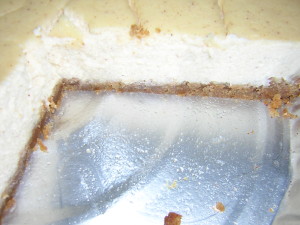 I probably should start by mentioning I am have chronically low blood sugar (hypoglycemia) and even more chronically low cholesterol. TH is diabetic, so we usually only allow ourselves a small slice in the evening –
Basic Cracker Crust:
nicely fills a 9 inch pie pan or the bottom of a 10 inch spring form
Ingredients:
1.5 cups finely crushed Graham Crackers or “Digestive Bisquits” or some cookies –
if you don’t get them fine enough – the crust won’t hold together – I have not had good experience with cookies with chips that melt (they burn) and nuts (can’t hold together and often to coarsely ground) so suggest saving chips and nuts for filling and toppings
Important quote: “If you won’t use butter, I can’t help you” Anthony Bourdain
6 Tbl Butter – Melted (lightly salted is fine – if unsalted, that will be fine too
1 Tbl Butter – Softened – use to grease pie or spring pan – not needed if you make the cupcake variation using cupcake papers.
—-
1/4 cup Honey – I tend to like things less sweet so use Honey rather than sugar because it takes less to get the same amount of sweetness – this also helps keep TH’s blood sugar in acceptable limits.
Someday I hope my Bee Keeping friends will send me some of their “flavored” honey to try for flavor variations. But for now, I just use a plain honey from a local keeper of bees.
—-
—— Your Choice COMPLETELY Optional —–
1/2 tsp of the flavor of your choice
My opinion is that the world is a better place with the addition of ground Cinnamon or a rich dark Cocoa powder or both.
— other choices might be – Vanilla Powder – and a recent addition to my flavorings – True Lemon, Lime & Orange Powder – These are great for when the filling is also Citrus flavored.
___
1. Generously Grease Pan of choice
2. Combine Cracker crumbs, Butter and Honey until all crumbs are moist.
3. Press into the pan of choice (pack it as tightly as possible)
4. Bake at 350 F – 8 minutes
5. Remove from oven and “smash it down” while still hot
6a. Use it today: Return to oven as quickly as safely possible and bake an additional 3 minutes
7a. Set aside – okay if it cools and if you like can also be refrigerated if you needed to get the crust done as a partial bake ahead.
8. Prepare Filling and bake according to filling directions.
6b. Freeze for later: allow to cool completely with pan on a rack –
bag/wrap in plastic and store in freezer up to 1 month. (more works, but not sure how it will affect final flavor.
I often make several and “stack” them for storage
cool in refrigerator until well chilled, wrap tightly
7b. Remove from freezer and allow to completely defrost.
=== if you plan a “no bake” filling like chocolate mousse – Preheat over to 350 F and bake about 3 minutes.
8. Prepare Filling and bake according to filling directions.
=== if you plan a baked filling – no pre bake needed.
Notes:
Fully prepared can be tightly covered and stored in refrig for several days without adverse effect on flavor
If you plan to freeze the shells, it is okay to omit the additional flavor and then use the same smaller amount to lightly dust the shell prior to adding filling. Lightly dust should be no more than the amount you would have added to the shell before baking .
Crust can be baked on a sheet pan and while still warm cut into shape to line the bottom of a cupcake paper or even smooshed into the cupcake liner and baked in your cupcake tin.
A neat dessert sampler can be made using the mini-cupcake papers and tins – with the basic recipe and then flavor dust – topped by the flavored filling (yes recipe to come)
again these freeze well, take less than an hour to defrost and the minis are also great semi frozen with a dollop of ice cream, or gelato.
last edited 2015-Sep-06
September 1st, 2015 at 04:42 am
I cannot emphasize how thankful I am to Anita Clark – I tend to write “as if we were in the same room and having a conversation”
With her help – this version has better grammar, several errors corrected and still, I think, retains the flavor.
Combined with the Fill the Gap Set Up & Movements.pdf – these are likely all you need and perhaps even more than you wanted to know about this easy and versatile braid.
You may download these complimentary files in our Facebook Group by joining us at:
Braids Beaded Kumihimo & More
Note: I am not trained as a graphic artist – so far all have been able to use the diagrams to make the braid. It may not be prettified, but it is apparently functional.
Enjoy The Making
Wheat
September 1st, 2015 at 04:02 am
These are “things that work for Wheat
You may need to adapt to your needs to get it right
August 11th, 2015 at 08:25 am
The nice thing about beadwork (or pretty much any craft for that matter) is that we are “allowed” to have favorites. those personal choices are all good –
Having been in this business for much longer than I care to admit in many roles (consumer, author, editor, teacher, wholesale and retailer)
The Retailer Reality is my needs as a shop are not what drives the market. The manufacturers choices are rarely easy on our inventory budget – because if we don’t offer it – in today’s world someone else will.
It is not really the decision of the Distributors – although they have minor influence in some aspects – it is driven by other factors.
SuperDUOs are “maturing” which means that with increased design support – there is a “designer” demand for more colors.
Personally I have come to believe that brick or click, no one can really stock it all, the best we can do is try to make it possible for you to “get what you want” – even if you have to wait a bit.
When I had my store I made it a habit to keep product catalogs accessible to my customers – and order what they asked for – EVEN when it meant I had to buy more than they wanted – so might have that excess around for a long time.
Today, as an online retailer – I try to keep that option open by being willing to admit I can’t keep it all in the store room, but I can, if customers understand some delay in shipping,
But, no way do I object to the new sizes and shapes – because if someone’s creative visions needs that size or shape, I really want them to have it.
And, oh by the way,,, I am always happy to see a product “in the chains” because I know they will never commit to the full line and people in today’s world will seek out what they want – my job is to help them get it.

