Note: The Amazon Links are affilitate links, however, I also suggest you look at ThriftBooks.com as some of my favorites come and go for paperback and hard cover and as far as I know, does not benefit me if you buy something.
DRAFT should be more interesting a bit at a time in the coming months.
So far, I have reviewed all of the KBS specific books. There are several that are an absolute horror story.
Many do not even have the correct order of ingredients. Much like many of the Instapot/Ninja Foodi books, just copies of others were the name of the machine is often not even edited. Not to mention those partially scraped by various website, usually without any credit to the author and often without complete details.
In my opinion, better to have a book that will help you understand the process of bread machine baking, AND offer a wide range of basic recipes with a few variations for each. Combine that with the Order of Ingredients and most bread recipes will work in your machine.
What is lacking seems to be a really good description of the various “functions” and how they are useful (i.e., the beginner’s confusion that often occurs between “raw” and “leaven” dough KBS has improved its “manuals” and there is lots of information specific to their products but written in a cross between “Googlish” or “Chinglish”. The features that are unique to those manufactured by Jiangmen KasgBaiShi (KBS) but sold under several (5 I am sure of) brand names. A project for a future time,
Bread (Mostly Machine) Cook Books and a brief overview
Easy-to-Follow Recipes for a Perfect Loaf Every Time. Step-By-Step Baking Guide with Simple, Healthy, Whole Grain, and Gluten-Free Options. by Stewart Brooks (Author) Brief Review: It was pleasantly surprising to see just how the content lived up to the hype. Product details – price subject to change Kindle List: $18.99 List Kindle Unlimited: Free Kindle File: 8.9mb Amazon ASIN: B0DL374XGJ Published: October 25, 2024 Language: English Paperback: 79 pages Amazon List: $18.99 ISBN-13: 979-8332320774 Item Weight: 9.3 ounces Dimensions: ? 8.5x 0.18×11 inches
DRAFT Review Outline: Pro: – Recipe Sizes for 1#, 1.5# & 2# – Recipe Ingredients: Most are readily available either thru Amazon or your local grocery store. – Instructions: although a bit basic, more than enough to answer maybe 80% of the average to adventurous beginner. (unlike so many that “assume” the reader has bread baking experience) Con: – Menu choice is not as obvious as might be needed by some, it is mentioned in the brief instructions – not as a “banner” as in the KBS guides.
The Image Below SHOULD NOT BE USED FOR DELAYED START I don’t do Delayed Start – Use at your own risk but it “works for me
Order to “Load Pan” First In = Bottom of Pan 1. Liquids 2. oils 3. (Yeast controls) Salt, Sugar 4. Flours 5. Vital Wheat Glutne 6. Yeast/Leaveners (Baking Powder,
NOTES: Sourdough. IF you are using “wet” sourdough, Sub 1 cup of Sourdough for 1 cup of flour AND REDUCE other Liquid (Milk/Water/Juice) by 25 % BE SURE TO MONITOR HYDRATION during 1st 10 minutes of starting machine.
7: Additives. Read Recipe instructions a time or three until you are sure what it is asking you to do. USUALLY the Additives beep is After the first Rise/Ferment and just as the second Stir occurs. NOTE: I also have chosen NOT to use the automatic thing for additives. I am fussy and it seems that EITHER it fails, OR, it dumps the ingredients, but as “ugly clup” so my preferences is to be hands on and roll in the additives after removing the paddle – time chart math may be required.
Misc to be explained, how to “time” when you need to come back to the kitchen to add things.
it It has always been one of the best times in our lives when we “made food” together as a family. The only difference really for parents today is so many recipes that are intended to bring your family together.
Why? because you will inevitably scratch the finish and then your bread pan is no longer safe to use because the Lord only knows what that base metal outside really is.
Sooner or later we all experience the dreaded “Stuck Paddle”
Now what you can do. It my experience that it is always best if you remove the paddle as soon as possible whether it is stuck in the pan or in the bread. In either case, once the crust hardens (and that is what is keeping the paddle from releasing) it just gets harder.
If you are fortunate, the first step to loosen and then remove a paddle is the “soapy soak”
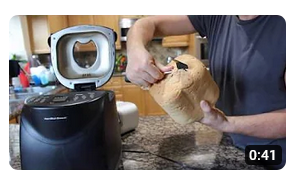
If not so fortunate, there is a method described (sorta – kinda) in all the manuals I have read for KBS MBF models that is really well demonstrated in this video (no idea if he has affiliate links, just sharing useful information.
If your paddle is still inside the bread
First, using the point of a wooden skewer, I try to make a small cut along the top edge of the paddle – this results in less damage (as in not a huge chunk out of the bottom on the loaf). Second, using the skewer, instead of a metal anything, as shown in the “Dad” video, gently lift the paddle.
Brief Explanation of “Bread Dough Goldilocks Tiplet” Overly Dense loaves are primarily caused by improper/over-hydration/too much liquid.
NERD ALERT” AP (all purpose) and Bread flour have different rates of absorption.
It occurred to me that it is quite likely the flours used to test the manual & QSG ingredient quantities – are not the same as those routinely available in the USA and Canada – many of my UK and Eastern Euro Friends & family have confirmed this as well.
It has been my observation that if I reduce the liquid(s) called for in any recipe, and then make adjustments during the First STIR/MIX cycle (about 4 minutes after start) the density has a much better chance to being acceptable.
Too correct, during the first mix, check the consistency, adjust by adding a teaspoon of liquid if too dry. OR… if too wet, a scant teaspoon of flour. Allow it to mix.
Touch Test – the dough should feel like a damp baby bottom. If you don’t have a baby to practice the test, dampen the underside of your forearm, and touch about 4 inches above your wrist. You want a little bit of “give” and while damp, not sticky “feel”