Also known as Jiffy Lace or Peacock’s Eye,
In Your Opinion, Is this type of Crochet
a Stitch
or
a Technique?
Please tell me what you think by voting in the poll
or better yet, share why you hold that opinion by commenting and voting
Wheat Wrote WHAT?!Whatever Is On My Mind – Links for things I use: InMySmall Kitchen to EnjoyTheMaking |
||

| ||
Also known as Jiffy Lace or Peacock’s Eye,
In Your Opinion, Is this type of Crochet
a Stitch
or
a Technique?
Please tell me what you think by voting in the poll
or better yet, share why you hold that opinion by commenting and voting
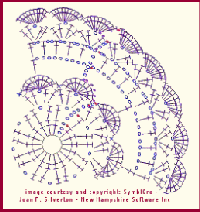
Pictures, sign language, and Symbols have been the timeless means to share everything from history to recipes.
Crochet Symbols are used in Charted Patterns. It is these Charted Patterns allow us to cross language barriers and enjoy the creativity of those with whom our only common language is the technique used in our craft.
Several recent discussions about Crochet software led me to take another look at New Hampshire Software’s SymblCro.
And, I might have just said, “this has to wait for another day” until I read the 1850 Pattern monologue* Caution: Be Prepared For PSA‘s in this complimentary pattern “explanation”
Apparently Joan Silverton shares my sense of humor and her free crochet pattern verbiage can make me laugh out loud, – that rates a deeper look into the product born of her frustration with that 1850 and toher vintage crochet pattern.
Stealing an hour from the “To Be Done File” including perusing the on-line forum, it seemed that perhaps a Yahoo group would be a better way to share information about Symbol Crochet and thus spread its use
The never humble opinion, I was wrong about what I said “in the past” The SymblCro is a program deserves to grow. It just already does so many things I want/need from Crochet Software Design tool.
Fortunately, Joan freely admits the “manual” is not the easiest, once you begin to make some progress on that steep learning curve, it is easy to see the huge potential of this program. Since this is currently still a free program, it only get “free time” and we all know how life can happen.
Being the patient sort that I am (not), and with the clear understanding that with rare exception, we are all likely rookies where SymblCro is concerned, and with informal agreement from its author, we set up a Yahoo Group to Focus on SymbolCrochet.
The goal of SymbolCrochet is to create a place where both those who use and those who design using Symbols crochet can share information.
Along the way, we may be able to create the basis of references and cross references and perhaps even help Joan to incorporate a larger number of symbols “into the program” and well as a wish list of things we “wish it could do”
So here’s the skinny:
Although nothing can really substitute for good reference books…
Current Use or Knowledge of SymbolCrochet, the symbols or the software is not required,
Basic Crochet knowledge will be helpful – If you are just learning to crochet and want to use “written” instructions, there are many wonderful groups.
For General Crochet Help, I happily recommend Crochet Partners as one of the best resources for beginner to advance technique help or one of the more specialized groups like Carol Ventura’s group for her passion, Tapestry Crochet when you need very specific “help” Another of my favorites is Kim Guzman’s yahoo group for Tunisian Crochet
The mission of SymbolCrochet will be how to use Symbol Crochet to complete your crochet work using instructions written using crochet symbols instead of “just words”.
Secondarily, to help each other over the learning curve, so we can most effectively use Joan Silverton’s SymblCro software for design purposes –
And who knows, in the process we might even develop some new cross references either for this blog or my dreamed of Crochet section for the YARNandTHREAD.info Wiki
We are still working on unpacking the boxes and arranging the furniture, so please excuse our dust.
I was pleased to read Carol Ventura’s recent blog-a-mentary detailing on her view of “Free” patterns and information.
Carol’s commentary opens the door to an important discussion and I would hope one that helps us all to understand the difference between that which an author/teacher choose to gift to Stitchers and that which is taken with only the most base of rationalizations.
So what is the issue?
It is about the MIS_USE of Complimentary Patterns, Charts, & Instructions
And, how often, almost innocently damage is done by that Mis-Use through a desire to “help”
Usually not realizing, but all to often simply not caring, if by helping some, you are hurting others.
It does not matter what the craft, but for today, it’s Crochet.
At the core of the discussion has to be and is the shared basic belief of the importance of “passing on the traditions”
To name just a few others, and in no particular order other than alphabetical by first name
Darla Fanton, Janet Rehfeldt, Jean Leinhauser, and
Kim Guzman
All of the above, like Carol, give of their time and expertise not just thru their publishing and teaching, but by their participation “on line” helping others to “learn the craft” and by offering help in a dozen other ways.
Aside from excellence in teaching and a dedication to producing quality patterns another thing all of above share is that they have been victimized by those who improperly share their work, both what is for sale and what is offered via the web on a complimentary basis.
When an author or publisher offers knowledge on their website, in a “group” or through “A-Longs” on their blog for your personal use, that is truly wonderful and you should take advantage of that offering for your personal use.
We need to distinguish what and how we can ethically share the information and knowledge offered for so tiny a price as to be considered free.
First, Personal Use does not grant you right to copy and distribute
Second, “Education” does not, unless you are a licensed educational institution, permit copying and distribution.
This means:
It is NOT OKAY to duplicate and distribute it without specific permission of the author.
It is not okay for another teacher to take that and share it by using it in their own classes without specific permission.
It is not okay for a shop owner to download and print out patterns – with or without charge
What is OKAY is to provide a link and then the “Personal User” will be obtaining the information in a fair and ethical manner.
Why, because as Carol so correctly pointed out in her blog
” Back to reality. Free patterns are part of my answer to (gaining) increased visibility – and it’s working. My books are not flying off the shelves, but they are slowly making their way into loving homes. “
The very small price these sharing individuals are asking is that the individual visit their websites, groups and blogs to obtain their gift to you the stitcher. They sincerely hope you will find the information and instruction they share for your personal use is helpful.
It is also, as Carol pointed out, their hope that as a result of that visit you will find their style and presentation will lead to your investing in one of their publications or taking a class with them.
Don’t we owe each of these sharing individuals that iota of courtesy and respect?
Shouldn’t we be willing to pay the tiny price of a moment of our time for all the instruction and inspiration they freely offer to us?
P.S. My thanks to Carol for raising this issue, and more importantly for that class at South East Fiber Forum so many years ago that taught me Tapestry Crochet – I happily recommend all of her books.
Whenever I need an acid dose of Yarn commentary, I spend a few minutes visiting “What Not” blogs.
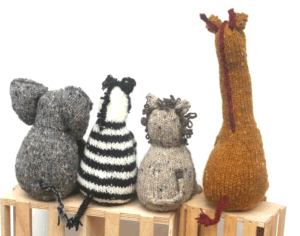
Often times I agree -especially when “Fun Fur” is involved – although it has its place, like maybe for the manes and tails of Knitting At Knoon’s Safari Animals
Certainly much of what is being offered today deserves at least a passing “What Were They Thinking”
Although it should be pretty obvious, quite Simply they may not have been.
.
Now to those passing thoughts or some might say, some snits & tizzys:
2. Why is the recurring commentary theme almost invariable related to “fit” – and it is the same over and over. Always talking about how the style is not fitted at the waist, shaped to the human figure.
Do the blogger and her commentators realize that some of the designs were not intended for either the anorexic waif or the hourglass figure shapes. Probably not, at least not anymore than so many of the those offering their work have “done their homework” in order to properly author a pattern.
3. One wonders what they look like and what they choose for themselves, but like so many who hide behind a “screen name” and a “free” server, we may never know.
So with a small WARNING, the following are NOT G-Rated and likely will offend many – but then you are reading this blog, so although I avoid profanity and sexual content, you likely can take strong opinions – even if written by those lacking the courage of convictions to sign their name.
Here are the links:
The New Season Start September 24 on NBC