August 11th, 2013 at 12:14 pm
Did you ever notice the same people who get all huffy about someone else’s opinion, rushing to claim it is a flame are usually just angry because they lack the capability to logically or reasonably refute your opinion, instead they just decide you are evil because you disagree with them.
And yes this does reflect some rather boring email rants recieved today.
July 30th, 2013 at 10:54 am

Fear Not, I have not given up on the New/Old Dr Who project but the recent receipt of a much better photo has created the need for a Plan B, or more correctly probably a Plan Z -and of course take care of enough business so we can continue to eat and maybe even get the mortage caught up.
Meanwhile, over the last few weeks, I have done, for our business purposes, quite a bit of “research” into Cords and threads and specially, SuperLon (S-Lon).
As part of my only have one place to update info project – the information has been placed in the Resources links at
Hope you find it helpful
Wheat
PS, with any luck at all, we should have listings for the available SuperLon (S-Lon) colors by style completed within the next day or so.
July 16th, 2013 at 12:53 pm
The first step in any project is always the planning and when you are working without a net (I mean pattern).
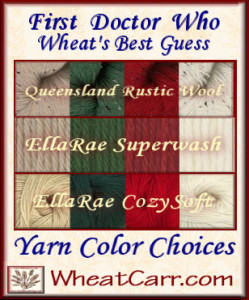 There can be either devils or delights in the details. for this project I tried (but did not succeed) to limit to yarns in my stash and further limited my choices to those presently showing a good amount of stock at the KFI and Euro Warehouses.
Queensland Rustic Tweed: 63% Wool, 27% Alpaca, 7% Acrylic, 3% Viscose blend with approx 318 yards per 100gram
Ella Rae Superwash Classic 100% Wool with approx 220 yards per 100g ball.
Ella Rae Cozy Soft Solids 25% Superwash Wool, 75% Acrylic with approx 213 yards per 100g.
Like all fashion products, it can certainly be gone tomorrow, but at least it is here today. As you can see, this time I got lucky, yarn choices are always an issue of availability. Might not be easy next year, but at least today I know the ones I am using “have stock in the warehouse” so I should be able to yarn requirements estimated
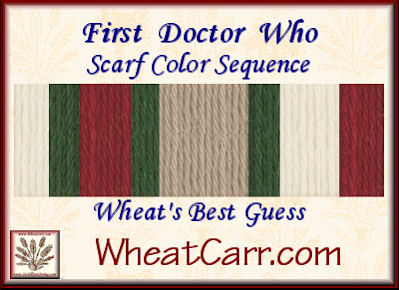 Last night I did this “digital” color stick – To lay out the color order and proportional width of each strip using the color swatch from The Ella Rae Superwash Classic. A color stick is used by designers to plan color sequences. When planning a sequence, it is basically the same as wrapping a ruler to determine the WPI (wraps per Inch) To get started, loosen about a yard of yarn from each skein adjusting the wraps to get the visual proportion you think best for your project. I like to start with the widest stripe.

In the Blastr photo, it appears the taupe is about 2 inches wide or a tad more. The Cream/Natural and green – although different, look to have a consistent width and the red appears to have both a narrow and a medium
Tonight I will make stick using the sequence and proportions based on “eyeballing the photo”
The photo version looks to be a simple garter stitch, so I will need to decide on crochet stitches (standard and tunisian) that will give a similiar textural appearance. It may be take a few evenings to get a good combination. For most project I would then make larger swatches so one can be washed according to the label instructions to be sure the texture and drape will hold up under normal human conditions.
For scarfs, instead of the larger swatch, Ms Barbie (she is the 36 inch tall variety – you may have met her a few years at go at TNNA) will get a 1/2 size version – her twin Ms Bink will too and it will be washed washed according to the label instructions to see if any adjustments will need to be made to the Pattern Gauge.
This step might take more than a few evenings but as long as the AC holds up, who cares if the heat index is 110 outside.
P.S. Please feel free to share a link to this page – however, I prefer you do not copy and paste to another site. Among the reasons for this is that I update when I find newer/better information to include. Here is the direct link:
https://wheatcarr.com/dr-who/dr-who-the-new-guy-scarf.php
P.S. Jr. Caveat Exercens: The information contained in this blog post is based on the opinion and experience of Wheat Carr. These instructions may not be suitable for use by children of any age. Parental supervision and judgement should be exercised. My results are not a guarantee of future performance or your results especially when gauge is involved.
This blog post was created by/for WheatCarr.com July 2013 as a Whovain Fan and is not intended for commercial use. The Doctor Who brand is a trademark of the BBC. No infringement is intended or implied.
July 15th, 2013 at 12:33 pm
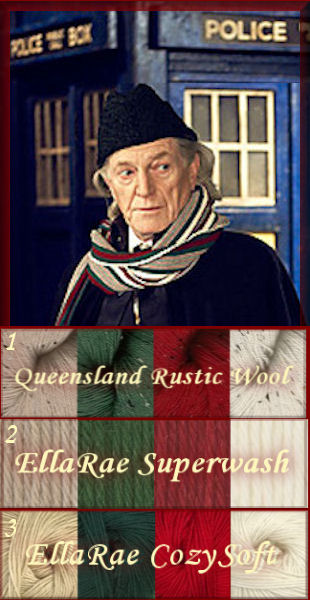 The BBC had begun to tease us (as if it is not bad enough we in the US have to wait months for new espisodes after season end in the UK) with the 50th Anniversary special scheduled Nov 23rd 2012.
Last week Blastr.com posted a story that included an image that included the detail I am showing on the right.
Looking back, I admit that it was disappointing when the series “did not make it” in the early 70’s until PBS brought us the 4th Dr in ’78 or so
Like many a string aficionado and die hard fan of pretty much every woman’s favorite Doctor, Tom Baker, I have made my share of the Dr Who Scarf
I have always loved the whimsical nature of the Tom Baker’s scarf, but can’t help but think this one will be a great GUY Gift for the Whovians in your life. I really like the “Victorian Christmas” feel to the colors in the David Bradley portrayal of the 1st Dr. Bradley certainly has plenty of acting credits so will likely do William Hartnell proud.
The yarn will be Ella Rae – Superwash Classic – a 100% superwash wool worsted that I really enjoy working with. Based on the complete photo, Bradley’s height of approximately 5’10” and my personal formula for how long a scarf should be – I think 90 inches should be about right to allow it to wrap twice as it seems to in the photo, and still have enough to fall about to the waist. Will have to find something similar around here and see how it drapes on TH since he is taller than Bradley.
As best I can tell from the picture, it looks like a fairly simple scarf, likely just a plain garter stitch – and I am sure LOTS of Whovians will be making a knit version.
I am still deciding whether mine will be Standard or Tunisian Crochet, likely both, but here are the Yarn Audition Finalists.
First the easiest, The red and the green and the white. I feel that an ecru/off white/natural is much more in keeping with the “Victorian” color theme. After much hemming and hawing over the weekend, it was narrowed down to a group from three different yarns
Ella Rae Superwash Classic, Ella Rae Cozy Super Soft and Queensland Rustic Wool.
Let the swatching begin
Anyone care to join me?
Wheat
P.S. Please feel free to share a link to this page – however, I prefer you do not copy and paste to another site. Among the reasons for this is that I update when I find newer/better information to include. Here is the direct link:
https://wheatcarr.com/dr-who/dr-who-the-new-guy-scarf.php
P.S. Jr. Caveat Exercens: The information contained in this blog post is based on the opinion and experience of Wheat Carr. These instructions may not be suitable for use by children of any age. Parental supervision and judgement should be exercised. My results are not a guarantee of future performance or your results especially when gauge is involved.
This blog post was created by/for WheatCarr.com July 2013 as a Whovain Fan and is not intended for commercial use. The Doctor Who brand is a trademark of the BBC. No infringement is intended or implied.
July 10th, 2013 at 12:22 pm
This day started with a lively telephone conversation with a lovely lady wanting me to accept a pattern return. Her request was based because it required her to have skills she did not. Turns out she had a good case for why I should accept the return.
The Craft Yarn Council’s Yarn Standards for Crochet Skill levels is located at:
http://www.craftyarncouncil.com/skill.html
Skill levels have always seemed to be the red-haired step child and for Crochet, One almost needs to be a psychic to figure out what they mean.
Vague descriptions like “using basic stitches” without saying what basic stitches might be is useless.
Thankfully most publishers now make a point of listing the “Stitches Used” and maybe even some instructions – certainly for “special” or “pattern” stitches” – I am quite willing to pretty much go along with the CYC when it comes to using its Crochet Chart Symbols to define Basic Stitches (in you want to know more about where we part company, it is covered in the post for tomorrow BasicStitches-Crochet .
It is my controversial opinion, that IF the Pattern Author gives a SKILL level, and has made it clear what they mean, then it is not reasonable to expect them to change/rewrite a pattern to a lower skill level.
And, if they have failed to make clear what the crocheter must be able to do, then they need to fix their publication format. This is especially true if they self-publish downloadable PDFs.
I also think that beginner patterns should include more instruction (basic stitch illustrations) and thus might need to cost more for printed versions. Again, with Downloads, the printing costs are not a factor for the Pattern Author/Publisher. The Crocheter can choose which if any pages need to be printed out.
One of the reasons the onus is on the Pattern Author is because, in my cluttered mind, Skill level should be defining what you need to be able to do to complete a project that includes various techniques. This does not seem to be the case in the CYC Skill Level definions. And so far, the CYC does not. For example
BEGINNER: CYC says: Projects for first time crocheters using basic stitches – minimal shaping.
Instead I would submit that the BEGINNER Crocheter needs to know how to:
- the SYMBOL and ABBREVIATION for each of the Basic Stitches as well as how to form/make these stitches.
- Basic Stitches about include: ch, sl st, sc, hdc, dc, tc,
- Basic Terminology includes: inc, dec, turn, join, rep and the symbols (if any) associated with them
- Nominal finishing such as at least one method for adding yarn and weaving in ends should be a part of the New/Beginner Crochet Skill level
- Along with Basic Pattern instructional abbreviations such as parenthesis, star/asterisks, daggers, and the symbols (if any associated with them)
EASY CYC says: Projects using yarn with basic stitches, repetitive stitch patterns, simple color changes, and simple shaping and finishing.
- I have long suspected the use of EASY was more about marketing than a level of competency.
I think this would/could be better called “Advanced Beginner” and I find I have used “Enthusiastic or Adventurous Beginner” qute often, because it is someone who has become competent in the Beginner/Basics and want to add to those skills – still relatively simple, but building on the basics.
-
Using a repetitive stitch pattern is certainly one of the most important second step basic skills. Most, could easily accomplish this if they take the time to do an “in pattern” swatch using the “special stitches” or “pattern repeats” contained within the pattern. This swatch allows them to begin the muscle memory building and working out issues such as tension within the motif or repeat.
- The SYMBOL and ABBREVIATION for each of the Basic Stitches, plus, the ability to read and insert a repetitive stitch pattern into a project (what the +# means in a stitch guide), Color changes (building on the adding yarn), simple shaping – someone needs to define shaping – what is minimal (I would say inc/dec) and what is simple – what additional skill/knowledge is needed. and finishing.
- Finishing needs to be defined, I would say basic finishing need to include more than just weaving in ends. It might/should include adding edging – picking up stitches around the pieces that will be combined to finish the project. Easy finishing also should include some methods for putting the pieces.
INTERMEDIATE CYC: Projects using a variety of techniques, such as basic lace patterns or color patterns, mid-level shaping and finishing.
- Intermediate seems to imply that one is able to combine techniques in order to create different textures and appearance within a single project.
- Mid-Level Techniques: particularly “in the round” and at least two of its variations – spiraling and stepping up. Anyone care to suggest some others that would fit here.
- Mid-Level shaping – The only thing that comes to mind is perhaps some ‘entry’ level free forming or the use of a sewing pattern for overall shape but fitting various stitches or stitch motifs into the shape could certain take some intricate shaping.
- Mid-Level Finishing – one word pops up immediately ZIPPERS & Button Plackets. Additionally perhaps including wet finishing, fulling, felting and other techniques that effect the texture and hand of the completed fabric.
EXPERIENCED CYC: Projects with intricate stitch patterns, techniques and dimension, such as non-repeating patterns, multi-color techniques, fine threads, small hooks, detailed shaping and refined
finishing.
- Frankly, I find placing fine threads and small hooks to be unacceptable as only something that can/should be done by an “experienced” crocheter. Historically, fine thread crochet to make laces was really where it all started. Yes, it takes a true love of the craft to work small, but skill levels are still varied.
- Moving on, once one has become competent and comfortable with all the skills need through the Intermediate level you are an experienced crochet and with care and thought should not be afraid to tackle any well written pattern.
Bottom line here, I really welcome and want to hear your ideas about Skill levels as I work toward including them in my Glossary aka/What Wheat MEANT when she said…..
Enjoy The Making
Wheat
CAVEAT: I may not rule the universe, but I reserve the right to disagree, even when “overall” something is valuable. In some cases, my reasons for disagreeing with the Craft Yarn Council is its underwriters are, t quite rightfully, not historically as concerned with many of the qualities (kinds) of yarns most often offered by an independent retailer like me.
That they even attempted to create voluntary standards is certainly to their credit – You might rightfully as this point mention “Pots and Kettles” and oh yes, I do know an Expert is just a drip under pressure… so – always feel free to let me know – publically or privately where I need to fix something and if/why you disagree.

