December 20th, 2013 at 06:38 am

Some might remember this blog started because my views were deemed too controversial to be shared in “groups”
Sometimes it is difficult to keep to the Libertarian (not to be confused with Liberal ) principle that demands if you want a right for yourself, you may not deny that same right to another.
Whether one agrees or disagrees with Phil Robertson is not the issue. Nor, technically is it a 1st Amendment issue unless you ascribe to the theory that the media is controlled by the government = It is really a business decision for both network and star.
For me, supporting Phil Robertson is NOT about the personal opinions he expressed, but rather my willingness to grant ALL the parties to the converstaion (Mr Robertson, NBC & GLAAD ) the right to express their views. And MY right to choose which of those is important to me and how I will choose to act.
To those carrying on about how could PR people “let” Phil Robertson take the Interview. It also means granting his detractors the right to hold and express their view
Phil Robertson is smart and likely knew that he was giving NBC a chance to get its way – it is an issue about supporting those who would suppress the right to hold and express a different view.
NBC may or may not be making a smart business decision, only time will tell. Once the new season starts and we can see if NBC takes advantage of the situation to “edit” out the content they have long wished to suppress, Well, I doubt it will kill me to cease to watch DD and Longmire the only two shows they offer of any interest to me. Certainly it will be easy to ignore all the others carefully designed to appeal the least desirable aspects of humanity.
What remains is whether all those upset will decide to do more than make short lived knee jerk reactions.
Will the majority of DD Viewers give up ALL the shows on that Network?
Are those professing support really willing to “boycott” the advertisers? Or just threaten to do so.
What if Wal-Mart or Cabella’s decides to drop the product line, will you stop shopping there? Seems to me much more effective to starve A&E of the ratings that drive the fees they can charge “sponsors”
It is interesting to see almost no comment from the family, and all things considered hard to believe they would consider staying with A&E without Phil and the freedom to express their professed family values.
It will be interesting to observe how many will allow themselves to be distracted from the real issues facing the country by a manufactured controversy and how many will take sustained action to support their beliefs.
No matter what any of us decide and what action we take – there are to many more important issues effecting our lives, our freedoms, and our country that need our attention.
November 24th, 2013 at 12:35 pm
Although not the only element in COGS (Cost of Good Sold) relates to the cost of your components = the second most common mistake I have observed is not using Replacement Costs when planning your price.
Not unlike insurance, your costing needs to reflect NOT what you paid for each bit and piece, but what it will cost you to REPLACE that item in your inventory.
What does she mean?
Recently I read in a “business” group of someone basing their selling price on the “deal” they got for one of the major components in their work.
Well, what happens when they run out of that, OR someone says, I want 25 of that design but in different colors. Or, you are working a local craft, flea or farmer’s market and up walks the “been looking for weeks but not buying” and want to know why that piece cost $5 last week but this time its $6.
It is always easier to lower your price than it will ever be to raise it, suddenly with no explanation. Nor does it make “sense” to the consumer when something that looks the same has different pricing without obvious – to the consumer walking by your table – differences.
There is often, especially for those who choose to create in an over crowded marketplace stuffed with similar products produced in less than fair trade conditions – can you really afford the “customer satisfaction” issue?
If you must – for some reason of your choice – decide to lower your price, then at least clearly mark it as a “special price” if asked, it is okay to say “I got a really good deal on the threads, but when these are gone, I won’t be able to replace them for the same cost”
Still if you are in this for the long run, especially if you are in the building stage of your business, far better to take advantage of the deal, but price the finished work as if you had to replace it “at full price” next week.
November 24th, 2013 at 12:06 pm
There is a sentiment that pops up fairly often on FaceBook about “When buying from an artisan (one who works with hands and heart)
While it seems geared to those who are buying our work, there is much in it to think about as you decide whether selling your work is really what you want to do. Anytime I accept a commission or am asked to sell a completed piece, here is what I think about as the Artisan/Maker.
One of the hardest decisions any artisan has to make is deciding if it even makes sense to sell their work. Is what your are making unique and thus can compete. Or, it is a hobby you and other enthusiasts enjoy – but frankly there are just too many sources for the same product you are making.
Is what you are producing for sale able to command its fair market value. I should warn you I have little patience for “what the market will bear” because if the market cannot bear to pay you a fair premium then you should not be in the marketplace.
While of consuming interest to you, really just a passing fad that may or may not have a permanent place at any level in the crafts market place. For example, two years ago it was friendship bracelets, this past year Paracord knotted bracelets were hot, looks like the next few months we will be seeing lots of rubber band jewelry.
Thinking about Paracord, of the dozens making Knotted items, I can only think of maybe 4 who are really producing anything approaching unique enough to build a niche in the market place for themselves. Maybe another dozen who are producing products to be used either to make the bracelets (jigs, charms, etc) that may or may not earn them a place in supplying the needs of enthusiasts.
You also need to decide if you are comfortable setting your pricing in a way that undermines the good of the craft for short term gain. If you are just into selling for the pin money, admit that to yourself as you consider your path
These are questions only you can answer, but if your work “looks” like a Wal-Mart special then it is going to be a tough road to over come the financial challenges that can easily take the joy of creating from you.
If not, then maybe instead of trying to make it a business, you should focus on enjoying this, building your skills, knowledge of your chosen craft and expertise. You might have to find another way to fund your hobby, but it just might be well worth the effort so you can continue to
Enjoy The Making
Wheat
November 20th, 2013 at 11:11 am
Introducing

Sooner or later everything reaches a tipping point. Or, as may not surprize – limitations and lunacy drive me to do start something. Past time to make some lemonade by finally launching a “dream project” AllJustString is intended to provide a place for personal development of our skills and knowledge, keep the information accessible and organized in a manner that will allow those who follow to find and benefit in a way not currently possible in other venues.
It is a founding principle that many of us don’t have craft-tunnel-vision – meaning that we enjoy many forms of craft and there is great diversity in how we each choose to bend our string. We can admire and respect those who practice a technique whether we choose to participate,
Our goal is help each other build on skills and knowledge and derivations – while giving our undying respect and support to those offering the opportunity to expand our knowledge and skill from the quick picture or video tutorials, to (at least in my home) a whole bookcase of others who have “done the research” and codified technique, and in many cases, the history of their chosen craft.
It is our obligation as an artisan (someone who works with their hands and their heart) to acknowledge as much as possible those who made our development possible. It is our ethical obligation to respect their copyrights and never feel we “need” to get attention by sharing that which is not ours to share.
At the end of the day, other than for marketing purposes, the only thing likely to be truly original is how you present it. And that work should be judged on your competence and vision.
Our goal is to help you find the knowledge and information you need, in a manner respectful to you, and to your sources of inspiration.
I hope you will join us – Ask and answer questions, suggest references, talk about your latest project – or show off what you have done – ask for peer review for a Work In Progress.
AllJustString, that gives us the freedom to enjoy one or many of its uses.
Blessing of the Seasons
Always Take Time To
Enjoy The Making
Wheat
October 30th, 2013 at 10:00 am
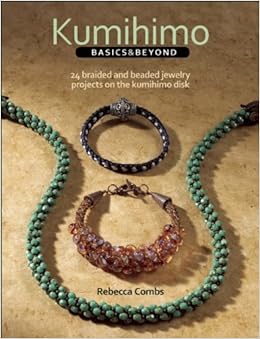
Received a review copy of the new book by Rebecca Combs – Kumihimo Basics and Beyond yesterday.
From a “Braider First” perspective”
Very mixed feelings, on the one hand I like that the author has apparently worked very hard to be accurate and use more traditional terminology.
Ms Combs did supply some “kumihimo math” – but one has to remember that is only going to apply to these braids. For those who preferred to have more detailed materials lists, each braid does have a well done supply list for each pattern supplied in the book.
There is great eye candy, and while I do not really object to “heavily beaded braids” it was disappointing to have it all be “only” 8 element Kongo except for one 16 element project.
There were some other small details, but it did a bit better than most of the books and pattern presently offered in providing some finishing information.
With an SRP of $21.99 US, but already showing up discounted on Amazon, this will be one we likely not choose to stock. but will order if a customer really wants it at the price we can afford to sell.
From the Bead Jewelry Maker Perspective:
with thanks to Carolyn for sharing her view –
Caroyln wrote: “I also got a review copy of this book, thanks to my local bead shop’s partnership with Kalmbach and my status as resident kumihimo instructor. I found that the book is really geared to a beading audience, someone who is looking to expand their variety of jewelry making techniques as opposed to someone who is looking to start in the discipline of braiding. That being said, for that audience this may be the only book they will ever need, and is a starting point for those wishing to go truly beyond.
All the braids in the book are round braid/kongo gumi, so once you have the basics of that braid down you can complete any project in the book. There is a lot of good advice on making braids, and this may be the only book that shows you what common braiding mistakes look like so you can see how to correct them. It’s an excellent first braiding book for those interested in the disk. The only things I don’t like about the book is that she ends every braid by gluing it into a bead cap or cone, and the author doesn’t use a counterweight unless she’s also using beads. ”
We seem (Wheat & Carolyn) agree, tThis would not be a book for someone already comfortable with basics of beading and braiding and ready to grow their skills for more diverse pieces.
However for someone wanting an low cost entry level to the most basic of beaded braiding, it might be okay as it is already being offered at less than I can obtain it thru my distributor, so we will be referring folks to Amazon where possible
Me, I am saving my personal money for the upcoming Jacqui Carey book due in January. In fact, already on order with our distributor.
updated:

