March 9th, 2015 at 05:53 am
every time I see the costing advice “2-3 x materials” it makes my teeth hurt.
If you do not respect your talent and expertise – no one else will either –
That means your first decision has to be to clearly define your goal.
Each of us has to make decisions about how we want to perceived. Why any artisan would choose to be comparable to Walmart is not something I will ever understand, but some do.
That means your first decision has to be to clearly define your goal.
The very idea of “what the market will bear” is so demeaning – If the market can’t bear the true value of your work, then you are in the wrong market.
Nothing can squeeze the joy out of creative work faster than turning it into the drudgery of making it a job where you are both under paid and under appreciated.
I know that not everyone has had the advantage of working in product development and so really understanding first the cost of manufacture BEFORE labor, the cost of labor, the overhead (all the business expenses shared over your entire business) and FINALLY the concept of PROFIT that must be added to the COGS (cost of goods sold)
I know it is just repeating what you have read “on the internet” and it seems like gospel. but 2-3 times the cost of materials is NOT what should be used for ANY hand crafted work.
Heck, that is not even the formula used by sweat shop manufacturing –
That might – very rarely – be PART of overall costing factor that is what is used AFTER all “development costs” have been recovered for mass produced items in less than nice places “for the workers”
If your goal is to be a “pin money” crafter, where all you really want is creative outlet and maybe be able to “replace” materials – that is your choice – neither good or bad.
If your goal is to seen as a professional, one who has invested time and money to learn their craft, then you need to rethink your pricing formula.
A large part of my life has been devoted to helping designers with tough love speech –
If you are in the pin money group, happy to recieve no compensation for time and talent and expertise then your costs, at the very least price for the COMPLETE replacement cost as if you had to make them the work again, and had to buy all the materials.
Or simply choose what many do, make for your own enjoyment and hopefully given as gifts to friends and family –
Obviously I have strong feelings about COSTING and how it effect PRICE – and someday I need to finish ‘the book” but if you are interested in considering more than slave labor pricing, – there are some blog articles starting at: https://wheatcarr.com/biz/pricing-pt-00-intangible-costs.php
If nothing else, please unload that gun you have pointed at your foot, respect the decisions of others instead of tearing them down for their business decisions and get past the bad business advice of applying mass production costing to hand crafting and above all – lose the false modesty, block the green eyed monster and decide what is right for you.
February 10th, 2015 at 09:08 am
In cold weather I find myself often focused on exploring food – TH likes this most of the time and early on in our decades together starting name the experiments he liked. So I could make a point of remembering what I did. In fact most dinners start with “What are we calling this?”
Inspired by a comment in a recipe group – today’s Passing (and perhaps prevailing context) thoughts.
Whether it is food or fiber work or any other aspect of a culture’s roots I prefer the commonality – the desire to give one’s family “comfort” using the best possible ingredients available and affordable.
Do you honestly think any ancestral home maker would have shunned the use of a food processor? Even and perhaps especially in many ways the Amish use technology – they just prefer people power.
Do you really think your great-great-grandmother would have found it preferable to hand sew a shirt rather than use a sewing machine and then have hours of time to spend on the embroidery or other fine details?
Is it really such a sin to use a circle cutter, rather than laboriously hand cut circles for whatever form of stuffed dough you and your family enjoy?
Are those who oppose machines also opposed to taking advantage of their home freezer to that found can be prepared in advance – meaning “on the day” they will have more time with family instead of alone time in the kitchen?
Quite frankly if they were not open to change and the opportunity to improve on their daily lives, would they have crossed an ocean as did the forebears of so many members of this group and migrate to North America?
No, I believe they would have welcomed the means to have time better used in other ways to provide comfort to the hearts and souls of their family and community.
I believe they would as reading accounts of every day life show, have made decisions based on their economic situation and the value of the “machine” – choosing to work and save for those most beneficial – I don’t have a dedicated machine for every food prep process, but I do have a Kitchen Aid with the specialty attachments that “cost justified” based on frequency of use.
Perhaps that is the tradition we should honor, careful use of our resources and not just acquisition for the sake of “owning”.
Yes, we should honor the past, allowing it to empower us in all ways while at the same time moving forward with respect for what brought us to this point.
February 9th, 2015 at 12:33 pm
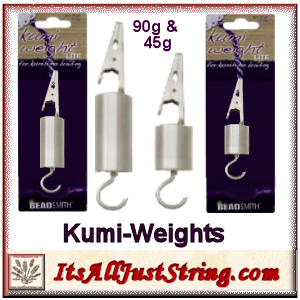
With the recent announcement of the new accessory for Braiding on Disc – the Kumi-Handle – it seemed like a good idea to address another braiding aid, the Counterweight.
Although I have spent many hours working with a counterweight on a disc so I would understand its use; I do not usually use one. Just not how I learned.
Shown above is the recently released (Fall 2015) version offered by The BeadSmith and the one you will most readily find in my e-store. There are many DIY Solutions and eventually I may put together a list but for today…
So for today’s addition to the “department of general information” espoused by Shirley Berlin – some background on the the three currently commercially available versions of counterweight. It is possible I missed some, but here is what I can “Verify”
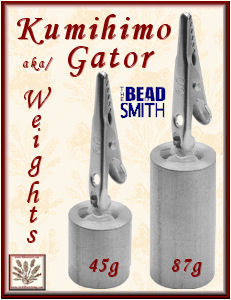
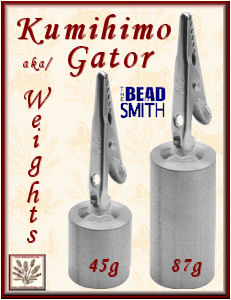
First produced in Canada by Jamie North’s partner – Kevin Swanson were the Gator Weights – but like many basically one man operations, with the explosion in braiding interest they apparently had some difficulty meeting demand. I know I often waited weeks for BeadSmith to get shipments and seem to always have the item in back order. These weigh approximately 45gm and 87gm and are slightly larger in diameter than the current Kumi-Weight.
About a year or so ago, the next addition to the counterweight field was put out by Beadalon. There version shown in the compatibility photo are intended for use with their spool knitter and for kumihimo.
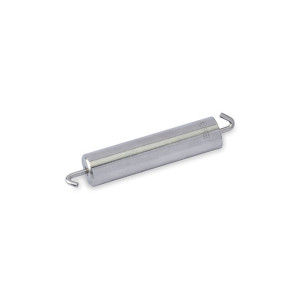
The Beadalon hooks are not unlike some machine knitting weights I have use. I have never seen these in person so cannot speak from experience. Like all tools I am sure they will have fans. Still given how I feel about the Knitting Machine hooks I have like that is the look of their hook – I suspect even at their much lower price point, they might not be my preferred solution when a counterweight is required.
Within the product description on my e-shop is more of my thoughts – but I admit to being amused that the first thing TH said was “you won’t use those, the alligator clip will damage your fine threads” – not an issue for those only doing beaded braids with SLon cord.
This all need more thought, but I guess if I were not up for some DIY solutions, then I like that the most recent entry into the market has both the alligator clip and a hook (although I know the folks at BeadSmith have no clue how I will use it besides holding down the table cover on the picnic table.
What is important – is the consideration for those reliant on the counterweight if they will also be using the new Kumi-Handle. With that in mind, I will continue to work with my Handle, use the weight and share my findings.

Looking forward to your thoughts, comments, correction and divergent opinions on to counterweight or not.
p.s. still fact checking the timeline, I know I have the order correct, just need to check further on the exact dates.
February 7th, 2015 at 08:08 am
Draft Last updated: 2015-Feb-08

Although this “timeline” is about Braiding on a Disc History, it would be remiss not to mention a little history of “beaded braids”
My goal in this article is to be as objective as possible – but I do have opinions and so some are going to leak thru. But yes, some of the links will lead you to pages at our online shop for Kumihimo “stuff” .
Braiding Disc & Square Plates are like any other tool – each of us will decide for the same and different reasons why we prefer one over the other. What may be worth mentioning while Kumihimo – The Art of Japanese Braiding dates back centuries – Braiding on Disc & Plate is a “modern” innovation and Beaded Braids are barely into its tweens as a mainstream craft technique.
Braiding on Disc and Plate is not the same as using a braiding stand – either the Marudai or a “flat top” or improvised equipment.
There are limited examples of beaded braids found in various museums in Japan and perhaps other places.
Until the late 1990’s when two things happened, most beaded braids where braided with traditional types of threads with beads sewn onto the body of the braid or used in tasseling finished work.
A few things happened that changed all that.
A Sample Swap on Compuserve with more than a dozen participants each prepared samples for the members of the study group and documented use of beads with braids. The shared experience created a niche of traditional braiders – using non-traditional materials.
 Inspired by the 1999 release of Jacqui Carey’s Beads & Braids, several “hot glass” beadmakers began to make, use and under duress, sell to their friends, some wonderful focals with large enough openings to allow them to be “threaded” onto traditional Fiber Only Braids.

The first place I “heard” about “Braiding On A Card” was in Rodrick Owen’s Braids: 250 Patterns from Japan, Peru, & Beyond – this book was published in 1995. It was a bit later, during a class with Rodrick, at the Weaver’s Place in Baltimore, Rod said that he had been introduced to the idea of using a card when studying in Japan.
My impression at the time was that he viewed the cards (round and square) as a tool to understanding a braids structure and as a means to work some braids – particularly the Inca (Peruvian) braids originally worked without any sort of tool to be more easily made.
2000: Makiko Tada showed the first Foam Disc and Square Plates when she came to the US for the Handweaver’s Guild of America Conference.
Somewhere in this time range, Shirley Berlin first offered “the red book” Kumihimo On A Card – sparking more interest among the traditional braiders who wanted portability and a simpler solution to sampling color and textures.
The term “MobiDai” was first used by Makiko Tada and she confirmed in the original Kumihimo group (after Compuserve – before Yahoo) that she had “invented” the term to describe the ability of the disc to be “mobile” It is my understanding that “Mobidai” could be considered the intellectual property of the Hamanka company of Japan. With this in mind, I now only use it when referring to the Disc or Square Plate designed by Makiko Tada to be used with the instructions she has developed specific to this braiding tool. and of course her Comprehensive Treatise Braids: Vol VI & VII teaching braids for Disc and Square Plate are expanding the possibilities
For about 2 years only two distributors – Lacis & Helby Imports offered these products. Both distributors were already “involved” in supplying related books and tools in the US.
Beginning in about 1998 – several braiders began “translating” braids intended for the Marudai (Japanese styled braiding stand) to be comfortable worked on the Disc and later the Square Plate. That process continues today.
Somewhere in this time frame (late 1990’s – early 2000’s) Toner Crafts introduced its “weave wheel”. Because it was/is intended as a “Kid’s Craft” it was both smaller and less expensive. It is apparently still a viable product for Toner Crafts and proved there was/is a viable market for a smaller disc.
NOTE: maybe include the Craft & Hobby Association story & discussion with Jeanette Crews Designs about the craft
The combination of demand for a less expensive, but closer to Makiko Tada’s MobiDai Disc and Plates led to the production and introduction of the BeadSmith Disc beginning approximately 2002-2003.
Shortly after, under the influence various designs used in Owens: 250 and after speaking with some already involved in beaded braiding – BeadSmith introduced its version of the Square Plate –
Over the years, several of us have advocated to BeadSmith for changes – I personally have emails going back and forth with Larry Weiss since early 2000 (not quite the first of which was me sending him two discs “glued” together with a larger center opening to allow for fully beaded braids. I know there are others long active in the both the bead and fiber art communities who have provided input.
With the possible exception of the product first introduced at The National Needlework Association in (I think) 2005 or 2006 – With an unfortunate choice of name (I did say some opinion would slip in here )
Inspired by nagging from many and providing my sales data of the smaller Toner “Wheel” BeadSmith added the 4.25 inch size and some bulk options that was about all that happened until 2010 This pretty much where it has stayed.
In 2011, BeadSmith, working with Ann Dilker created a pamphlet showing some beaded braids and put together some finding sets packaged as “Kumihimo Findings” really stuff they were already offering to their independent retailers but it really seems to have proved to be the missing link.
Since 2011, it seems like every one with a toe in the bead and jewelry business is offering their own version of the Disc and some also the plate. Beadalon was likely the next to create its own private label disc about the same time they began producing their version of the Kumi-Weights in China for sale in the US – Another interesting story in itself.
Among the innovations is a 64 slot disc (not recommended), some smaller approximately (7.5cm to 8.5cm) = both okay with fine threads, but not comfortable use for even partially beaded braids without significantly enlarging the center opening and awkward to use with even the smaller size 1 & 1w Bob EEZ or embroidery floss cards, etc.
Keeping in mind personal preference – sometime in 2012 Sally Battis introduced her thicker disc – it was interesting recently to read her explanation for the beveled opening – I like the concept because it encourages beaded braiders to use the same technique traditionally taught by the master braiding teachers where braiding if often done a disc or plate relying on good technique to keep the tension adjusted rather than a weight. Again personal preference.
Most recent (announced to its Retailers in January 2015) BeadSmith has also introduced a thicker “double density” disc in both sizes with a significantly larger center opening – 35mm (approximately 1 3/8 inches). along with a “handle” that may prove to be useful for some.
…. To be continued – or revised or added to as time and energy allow
P.S. All with interest in beaded braiding are welcome to join the conversations at my small FaceBook group for Braids Beaded Kumihimo & More at:
https://www.facebook.com/groups/Beaded.Braids/
P.S. Jr: With thanks to Makiko Tada, Carolyn910, Larry Weiss,Janis Saunders,and Sally Battis for their assistance in assembling the facts and chronology. And to Hamanaka, BeadSmith and Beadalon for providing product to “confirm” the details. To Brad Colisomo of eXtremePara.com for his technical assistance in the development of the speciality disk for use with wire and paracord.
Other brands of Disc and Plate were purchased “at retail”.
October 12th, 2014 at 07:02 am
Braid thinking out loud – there is a conversation in Kumihimo Beaded Braids that reminded me of a tip of sorts I had been meaning to share.
Although I do not have a smart phone, I do have an OLD Video Camera that I use exclusively to develop instructions and to determine where my execution of instructions is going horribly wrong.
Most recently I applied that to introductory Kumihimo Braids and more specfically what could be done to help those who want to move from disc to dai.
It has long seemed to me that the biggest & easiest issue to lose site of in the transition is so many do not understand that they are different. While I know some agree, it may well be we under estimate how long it is going to take for our frontal lobe to be convinced and as a result our progress and certainly our speed of execution is hindered.
So how to “fix” this. Flying in the face of conventional wisdom – creating a new Paradigm – and likely severely annoying a certain segment with the bead & braid world since it will mean rethinking and perhaps rewriting instructions – not to mention all those you tubes and free tutorials that (at least in my never humble opinion) hinder the growth of the braiders knowledge and skills.
For some time, my mantras were altered to start with “on this disc” and “on this dai” – AND I really needed to find out why I seemed to be having so much difficulty reacquiring the needed muscle memory as well as why I seemed to be losing it between projects.
In a effort to more objectively evaluate where I am going wrong, I used the video camera to see what I was doing and find the errors of my ways. The BFOO (blinding flash of obvious) there is no reason why a disc must be used with only one hand and in fact that is a detriment to the student to insist they should
It seems such a simple answer, using two hands regardless of the tool – disc or dai. Why not teach – to quote a wonderful Quaker lady a bit out of context – to start as we mean to go on. I have always found the reliance on numbers (and the tedious lines of instructions that creates) a hinderance. In braiding it is and should be about the movement and flow, not about moving eyes from page to disc to find the numbers.
I suppose this “thought” has been brewing for sometime and might just be why I “Suddenly” needed to work the introductory braids in Art of Kumihimo on a disc. A project that went more quickly because of using two hands as I would to have followed the information on a Marudai and when I then moved over to the marudai – was back up to speed within one full sequence of moves, instead of several inches of braid.
Further the self critique reminded me one of the reasons I like to braid is the use of two hands. now I deliberately use both hands prefer to use two hands with the disc is because when analyzing my own technique that there was a definite correlation between which tool I have been using more heavily and how long it took to get back the skill level previously enjoyed.
As always, since I already know what I think, I hope you will share you thoughts with me.
Now I need some guinea pigs to test my theory – hoping my braider friends will give it a try and let me know if it helps their transition from disc to dai.