This post may contain Affiliate links, see full disclosure note Links in my entries usually open in a new tab.
in 2025 BJ’s “shipping” was unable to delivery correctly more than a dozen times which by the way is EVERY single order I was dumb enough to have shipped.
In 2025 Instacart correctly delivery – on time and usually in the first 10 minutes of the 2-hour window in 47 of 47 deliveries.
Yesterday, instead of spending useless time trying to get BJ’s and/or FedEx Ground to accept responsibility for misdelivered urgently needed items I did the math.
There are FIVE “bulk” items I buy every month from BJ’s. for years we have maintained a separate Same Day Delivery account.
TWO of the five are no longer available thru Same Day Delivery “in this area” . And no, free shipping is not free if the product never reaches you and you are forced to find it elsewhere at a higher price.
So I did the math. Instacart for the win, again. I use Instacart for several reasons.
Now added to those reasons is keeping my blood pressure lower. Given the competition, at this time (Jan-2026) the monthly cost to use Instcart for my BJ needs is approximately $5-$10 per month. – that means for $60 annually I am not aggravated by having to deal with repeated mis-delivery (for the records, BJ’s/FedEx-Redidential have not properly delivered any order in the past 18 months)
That means I can pay Instacart an additional $10-$120 and NOT use BJ’s delivery services. And yes, I do keep track of what we use and buy whenever possible locally when on sale so that takes care of another dozen products I might have purchased from BJ’s
In 2025 it cost me an additional $150 in “lost” misdelivery that no one accepts responsibility for and would have been more except for kind folks who saw the package and brought it to our door. Full disclosure – after one other missing shipment that was valued at more than $100, they agreed to refund the $55 – and yes, we supplied images of their supposed delivery.
Looking 2025, IF I had used Instacart instead of BJ’s either shipping or same day delivery, the TOTAL added cost would have been $111 to Instacart instead of $100. Yeah for $11 – less than $1 a month, this delivery dependent person will not be renewing any delivery, Same day or shipping, thru BJ’s.
Draft, but “IMNHO” enough useful details to be helpful to some. Please feel free to as for additional details or clarification
My Criteria: 1. Is NOT a conglomeration of recipes cut and pasted from the work of others, but rather recipes have been formatted to conform within the book and therefore, are easier for the average person to use with some confidence. Generally I honor my upbringing to say nothing unless it is nice. This links to a book that “made me” break that rule: https://wheatcarr.com/2023/06/25/dont-buy-kbs-bread-machine-cookbook-150-simple-and-time-saving/ 2. Recipes that will work with my machine – at a minimum ingredient lists and if “settings” for: Bread, 1, 1.5 & 2 pound machines AND use WORDs not numbers for menu selections. Note: even within a single brand those numbers may not be consistent. Ninja Foodie/Instapot/Electric Pressure Cooker/Air Fryers 3. NOT Necessarily Machine Specific – but if it is it better be complete details. 4. HUGE PLUS if the format used happens to mirror your/my machine recommended order of ingredients. Especially important for Bread Machines 5. Enough details in the General Info section at the front of the book so that even beginners can work with the recipes. 6. Enough Photos to give a good idea of the ideal finished product because not every one is comfortable with the “older but invaluable” almost textbook timeless treasure from Michelle Anderson & Beth Hensperger. 7. Most (preferably all) recipes include both imperial (lb/oz/cups/tsp/Tbl/etc) AND Metric (grams/ml/etc)
This criteria has been applied to the following recipe books – none are “prefect” for every user, but they are IMNHO worth the price (and trust me there are some where “Free” is too high a price.
Michelle Anderson Stewart Brooks Beth Hensperger
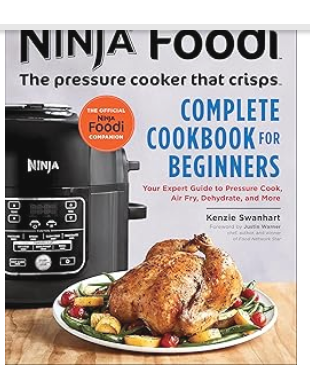
The (first) Official Ninja Food Complete Cookbook for Beginners by Kenzie Swanhart For the Ninja Foodie Series 300 and 400 this is an excellent reference for most skill levels. It was extremely useful in helping me to adapt my favorite recipes from traditional stove top or oven methods. It appears that this product is manufacturer discontinued. Guess that means I need to start thinking about a future replacement.
Personal Reaction/Review: While not a huge sports fan, it was fun to find members of my Dad’s extended family mentioned. Each of the featured sportsmen has a “2-page spread” sort of like a detailed Obit. However, as someone new to “on-line” genealogy, I am really happy to have the list of resources for more information on the Carptho-Rusyns and of course happy to have supported the writer in what I suspect was very much a “labour of love” project.
Between 1880 and 1914 nearly 250,000 people, known as Carpatho-Rusyns, immigrated to America from a region in Eastern Europe called Carpathian-Rus’. Prior to 1918, Carpathian Rus’, which comprised a land mass similar to the size of New Jersey, was part of the Austro-Hungarian Empire. It is located where the present-day borders of Poland, Slovakia and the Ukraine intersect in the Carpathian Mountains.
Rusyns, prior to the start of World War I, were primarily illiterate peasants, who lived in small villages and owned tiny five-acre farms, raised livestock, like cows, chickens, goats and sheep, on land unsuitable to produce sufficient crops. To escape the hardships of their native land, Rusyns sought a new life in America. Many were quickly recruited by mine owners as cheap labor to perform hazardous and hard work in the Anthracite coal fields of Eastern Pennsylvania.
Later, steel magnates targeted Rusyns to work in equally dangerous jobs in their mills and related industries in Western Pennsylvania, and adjoining towns and cities in West Virginia and Ohio. Other Rusyns found entry level employment at plants and factories in the metropolitan areas of New York, Cleveland, Detroit, Chicago and Minneapolis.
While these newcomers found it difficult to move up the American social ladder, their first generation Rusyn American sons were eager to assimilate into America. Some viewed American professional sports as their opportunity to achieve success. A few found fame as professional boxers, but most gravitated to America’s most popular team sports at the time – football and baseball.
Two Rusyns – John Jadick and Pete Latzo – became international boxing champions in the 1920s. Ducky Medwick and Nestor Chylak both reached Baseball ‘s Hall of Fame in Cooperstown, N.Y., Medwick as a player and Chylak as an umpire. John Kundla was selected to the Basketball Hall of Fame, for coaching the Minneapolis Lakers to five world championships in the late 1940s and 1950s.
They Came to Play is about the history and homeland of the Carpatho-Rusyns, and about the challenges they faced to become accepted and recognized in America. However, the major portion of the book profiles the lives of the five aforementioned sports figures, and 40 others with Rusyn ancestral roots, who worked hard to reach the top level of their professional or Olympic sport.
These 45 individual served, and continue to be, an inspiration to people with ties to Carpathian Rus’. They demonstrated to their fellow Rusyns that persistence and a strong will could lead to success in whatever career path they chose. By 1960, many second-generation Rusyn Americans had earned college degrees, and advanced up the social ladder, and had assumed major management and professional roles in American business, industry, government, education, and health care.
Amazon Details: Product details Dimensions: 6 x 0.35 x 9 inches ASIN: B0FJ5VKS3D Publisher: Independently published Publication date: July 29, 2025 Language: English Print length:153 pages ISBN: 979-8291466407
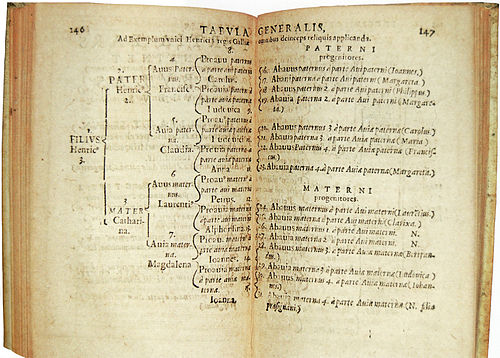
What is the Ahnentafel? According to wikipedia: Ahnentafel, also known as the Eytzinger Method, Sosa Method, and Sosa-Stradonitz Method, allows for the numbering of ancestors beginning with a descendant. I like the Ahnentafel system because it is a nice balance between “just the facts”and a bit of narrative. Now I just need to learn how to properly modify the standard template in RootsMagic to include comments & notes.
Shown below is an image from Wikipedia that is from “The first Ahnentafel, published by Michaël Eytzinger in Thesaurus principum hac aetate in Europa viventium Cologne: 1590, pp. 146-147, in which Eytzinger first illustrates his new functional theory of numeration of ancestors; this schema showing Henry III of France as n° 1, de cujus, with his ancestors in five generations.”