» Currently browsing: Tech-Talk
August 2nd, 2014 at 12:00 pm »
Comments (2)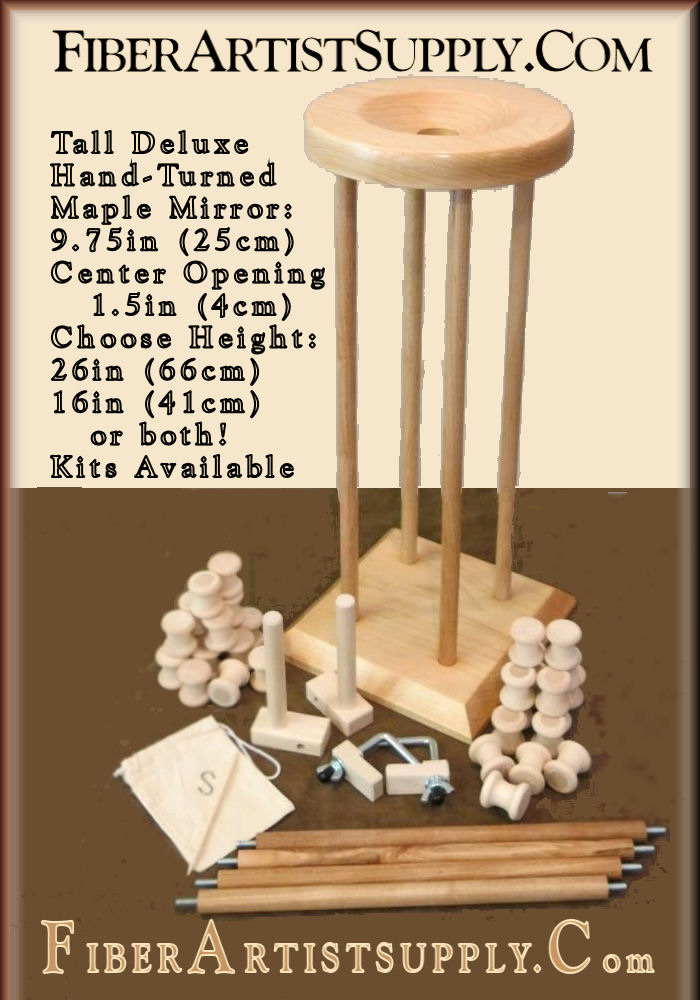 In case you missed hearing about my present of the year, well maybe 2 years – this is about the FiberArtistSupply.com Deluxe Marudai kit –
Apologies in advance for gushing more than a little. Wheat (me) is an especially happy customer of FiberArtistSupply after recently receiving my “dream” Kumihimo equipment.
Tim Hale and his company, FiberArtistSupply have been supplying affordable quality tools to the yarn community since about 2007 – when I saw the photos of Tim and his family on Facebook, I was surprised that he is such a young guy – great news for the yarn users of the universe.
Since 2008 I have acquired more than a few of Tim’s Tools. Now, I am grateful that about the same time I decided it was time to follow the tradition of commissioning a marudai to meet my personal needs, Tim was just about ready to embark on a “redesign” of his Marudai and gave me the the opportunity to be among those providing input into the redesign.
I love traditional fiber as much as the quite recent practice of adding beads and other inclusion into the braid. (and, yes, have always know that what I was doing was braiding, but not exactly Kumhimio) My biggest wish was for a larger than usual center opening for the mirror than is now standard for Tim’s Tall Deluxe Marudai. My “kit” included both weights of tama – a minimum of 16 each and both sets of legs.
The 9.75 inch diameter mirror is excellent for my preferred 8-16 tama projects and adequate for the occasional mad foray into 24 tama braids. My goal is to eventually add another 8 as I use them as both tama and counterweight.
One of the issues with the taller “American” style of Marudai is that the traditional friction fit for the legs to allow easy set up and take down gets a bit wonky and wobbly. Add in the sometimes less than perfectly controlled movements for someone regaining muscle use and memory and Tim’s new screw in legs are a personal Godsend.
A compromise was needed related to the finishing. As a young woodworker Tim has some strong feelings about finishing. After listening – I had to agree that if the result was a more appropriate finish there was no reason not to take advantage of the kinds of finishes available today for the Marudai mirror.
So, after months of “engineer meets artisan” that included lots of me explaining WHY that detail was important in terms that would appeal to his sense of engineering and my desire for a reasonably traditional work and his educating me the nuances of creating a design for hand crafted production it finally arrived (early July) – I have been braiding happily away on samples for a future book “to test” the limits of my new toy and am not the only one amazed and amuzed to find nothing I would change or wish was different.
I am not sure if Tim will consider working on a custom project anytime soon (and I take full responsibility and hold him blameless) but am very pleased with the outcome of this one.
The only thing left on my braiding “I want” list are larger capacity bobbins and rumor has it Tim will be solving that problem for all very soon – well that and more time to braid and bead and weave, and most important of all ….
Enjoy The Making
Wheat
Oh, almost forgot – for ordering, pricing and availablity, visit FiberArtistSupply.com and check out the Kumihimo tools. Web Links Open In New Windows:
Kumihimo Tools at FiberArtistSupply
E Mail FiberArtSupply
Telephone: 847-530-0816
Email FiberArtistSupply
CC: Kumihimo Marudai Resource Links
CC: AllJustString.com Forum
FB: ItsAllJustString.com
April 9th, 2013 at 08:55 am »
Comments (7) It never ceases to amaze me how the simplest and seemingly most straight forward of situations can evolve into an ethical dilemma.
In this case. someone is searching for a pattern.
It is in an out of print book
Someone else, who probably had the best of intentions,
but with no clue to the intended consequences of their actions…
Reverse engineers the pattern –
An “okay’ thing IF their own use – not distribution
Not when that derivative pattern is “shared” in many places.
(a blatant violation of copyright in ALL the countries involved Japan, USA, UK)
So now, abetted by the services posting/hosting the “Free Download” violated international law, The Geneva Convention.
And the moral dilemma, well, should I also abet the IP Violation by tell the searcher how to find the improperly shared patterns – justifying with “well then they will like me”
or rationalizing “The damage is already done, so why not”
Or, like our parents always said, “If they were going to jump off a bridge, would you do that just because they already had”.
So I really want to know,
What Would You Do?
How would you handle the situation
and why would you choose that method.
I look forward to your thoughts here, or on Like: FaceBook
Enjoy The Making
Wheat
MAIL: Wheat@ItsAllJustString.com
Read: Wheat Wrote WHAT! http://www.WheatCarr.com
Shop: ItsAllJustString.com http://www.ItsAllJustString.com
Like: FaceBook – http://www.facebook.com/ItsAllJustString
February 9th, 2012 at 09:53 am »
Comments (5) In a pretty much unrelated conversation in a designer’s group, a comment was made that “got me thinking” about one of my favorite topic – Standardization.
This is not really to say that how a technique is taught should be standard, but what the end result “looks like” should have a common name.
As most know, I Love Standardization and several of us are currently involved in trying to get some into Crochet beyond the 5-8 basic stitches. There is another group that tries very hard to create at least standard terms in “English” for Japanese Braidmaking – Kumihimo.
Not making a judgement here, but I have never understood calling the part of a “threaded needle” project that was the “Stitch Key” a graph or a chart. Although I can, for purposes of illustrating stitch placement see where either term could be reasonably interchangeable.
However the dilemma is that terms “cross craft”. We could spend hours and pages on why, but let’s don’t and just stipulate that it is so.
Using graph as an example, to say that it is limited to Cross stitch just does not work. Graph is commonly used in Crochet, Knit, Beadwork, weaving – Not to mention the one place where it does have a fairly standard meaning – Math and in every case including Math – if there are more than one person at the table, we could site at least 1-4 other terms commonly used to describe again placement be it of stitches or color.
Parallel development is so common in craft technique that there is always going to be someone who thinks they “invented” a stitch or whatever and even when others can, often as not, show that the “end result” of the stitch already exists, with a different name but with the same steps in its execution – they will still choose to claim authorship and name it as they please.
Then you have the main stream (or as main stream as niche publisher can be) craft book houses who have, because of the vacuum in established standards, make their own so at least the bulk of their publications would be the same and thus more usable for the consumer.
Is there an answer to this? Probably not, that won’t stop some of us from trying to make it easier for those who love the techniques from trying to make it easier for all to share.
Maybe we need a “Design Author Pledge” where egos are set aside and common factors are defined, common names used, and then it will be up to the individual to decide how to teach the process/technique.
Okay obviously I needed something to rant about – but really, what do you think?
Enjoy the Making
Wheat
P.S. A thank you to Linda Reinmiller for her comment that helped me “finally finish” this commentary
October 24th, 2011 at 12:01 pm »
Comments (0)If the purpose of your signature is to help increase traffic,
Then DO NOT ASSUME that just “www” is enough.
Many email readers need you to includ
“http://”
So that the link appears “clickable”
Wheat
read: Wheat Wrote WHAT !!! http://www.WheatCarr.com
shop: ItsAllJustString http://www.ItsAllJustString.com
June 18th, 2009 at 00:01 am »
Comments (2)First a note to the person(s) authoring recent highly irate drive by emails, expressing their opinion that there was no possibility this would come up again…. because the US Government was too busy instituting Socialistic take overs of private corporations…
Truth is, I kept hoping you were right – but here we go again.
And if you care,
Then best you get ready to defend them… Again
I know many of us have been working on effecting the final form of the CPSIA legislation, but it looks like we will soon be back on the front lines of “Orphan Works Opposition”
This writer has been on target before, so fasten your seatbelts.
http://copyrightaction.com/forum/orphan-storm-warning
Please remember – the best way to reach your congressional representatives & senators
is to call AND write to their district offices. Mail to the Capitol is often delayed because of security concerns.
The “ranking” of response is:
Telegram (costs money)
Letter (costs nominal funds, but time)
Telephone calls (make them frequently and be sure to say you are a voter in their district. if you work from home like me, put the number on speed dial, and call every day.
Ask, if they got your letter, Ask if the Congress Critter has read it.
Email is almost useless. Unless you have a real email for the proper staff person, it may not even be read. Of course, filling up their email box has been known to get their attention
To learn more about the Orphan Works Opposition, please visit
http://www.owoh.org
Wheat
